As an Amazon Associate, we earn from qualifying purchases. Some links on this site are affiliate links at no extra cost to you. Our recommendations are based on thorough research and editorial judgment.

Calculating Electricity Savings With Radar Motion Sensor Bulbs

1) Method: One calculates baseline kWh by multiplying fixture wattage by hours, subtract projected active hours with radar sensor, use measured activation percentage (e.g., 50%), and convert to kWh. 2) Example: A 60 W LED running 12 h/day yields 0.72 kWh/day, with radar at 50% active reduces to 0.36 kWh/day, saving 0.36 kWh/day. Calculation includes sensor draw (~0.5 W), maintenance, payback at $0.13/kWh. Further sections follow for calculation templates, regional tariff adjustments and examples below.
Key Takeaways
- Measure baseline lighting energy: record wattage, daily hours, and days to compute monthly kWh before sensors.
- Estimate sensor activation percentage: use occupancy patterns to predict fraction of time lights stay on with motion control.
- Calculate kWh saved: multiply baseline monthly kWh by (1 − activation percentage) to get reduced consumption.
- Convert to dollar savings: multiply monthly kWh saved by your electricity rate ($/kWh) for monthly and annual savings.
- Include sensor costs and maintenance to compute payback period and ROI, and adjust for LED pairing and sensitivity settings.
How Radar Motion Sensor Bulbs Work
- Overview: Radar motion sensor bulbs employ microwave radio waves to perform motion detection through obstructions, providing broader coverage than Passive Infrared sensors, improving energy efficiency by reducing unnecessary illumination. These devices detect movement at ranges typically between 5 and 15 meters, adjustable via sensitivity controls, and trigger automatic activation of lighting circuits to minimize energy consumption. Motion detection ranges for these bulbs can vary significantly, with some models capable of detecting movement up to 33 feet.
- Operation and implementation: The sensor emits continuous low-power microwaves, measures Doppler shift to confirm motion, filters minor perturbations to reduce false triggers, and returns to standby when no motion is detected for preset intervals, commonly 30 seconds to 10 minutes. Example installation: orient bulb for 10–12 meter corridor coverage, set timeout to 2 minutes for frequent use. Reassuringly, calibrated settings balance responsiveness and savings. Monitor performance periodically.
Types of Radar Motion Sensors and Technologies

Radar motion sensors fall into several categories based on operating frequency, waveform type, and signal-processing architecture, each category presenting specific detection characteristics, effective range, and installation constraints that influence performance and energy savings. 1. Frequency bands: X-band (10 GHz) and K-band (24 GHz) offer ranges from 5 to 30 meters, higher frequencies enable finer resolution, they detect movement through thin materials and support precise zone control for parking lots and corridors. 2. Waveform and processing: continuous-wave and pulsed radars use Doppler or FMCW processing, FMCW provides distance measurement, reducing false triggers and lowering electricity consumption via shorter activation. 3. Implementation: sensors with adjustable sensitivity settings paired with energy-efficient LED lighting maximize energy savings while ensuring reliable coverage. Proper calibration maintains consistent measurable savings annually. Wireless sensor lights, such as those with automatic activation, help conserve energy while offering enhanced convenience and security.
Key Factors That Influence Energy Savings

When evaluating potential energy savings, 1. Occupancy and usage patterns: Measured savings typically range from 30% to 90%, depending on occupants per hour, duty cycle, and uncontrolled idle time, which dictates baseline lighting energy consumption. 2. Sensor technology and placement: Radar sensors provide wide-angle detection through materials, they reduce false offs and should be mounted to cover primary motion corridors, with installation location affecting trigger reliability. 3. Fixture and lamp efficiency: Pairing with energy-efficient LED fixtures reduces wattage per lumen, improving payback periods from one to three years. 4. Configuration parameters: Sensitivity settings, timeout intervals, and integration with controls determine activation frequency and total savings, implement calibrated testing to optimize results. Regular maintenance, such as periodical battery replacements, can further ensure optimal performance and energy efficiency over time. Record consumption, calculate kWh reductions, and refine sensitivity and timeout values periodically.
Recommended Products

💡 Energy-Efficient Solar Technology: XCQMHF solar street lights harness advanced solar technology to provide a high-efficiency and environmentally friendly lighting solution with zero electricity cost. Perfect for both residential and commercial uses, it saves on your electricity bills while contributing to Earth's wellbeing.

💡 Energy-Efficient Solar Technology: XCQMHF solar street lights harness advanced solar technology to provide a high-efficiency and environmentally friendly lighting solution with zero electricity cost. Perfect for both residential and commercial uses, it saves on your electricity bills while contributing to Earth's wellbeing.

【Dual Intelligent Sensor Modes】This solar street light supports two working modes: dim light when no motion is detected and bright when people approach, or off when idle and full brightness when triggered. The radar sensor detects movement up to 6–8m away, saving energy while ensuring security.
Calculating Daily and Monthly Electricity Savings
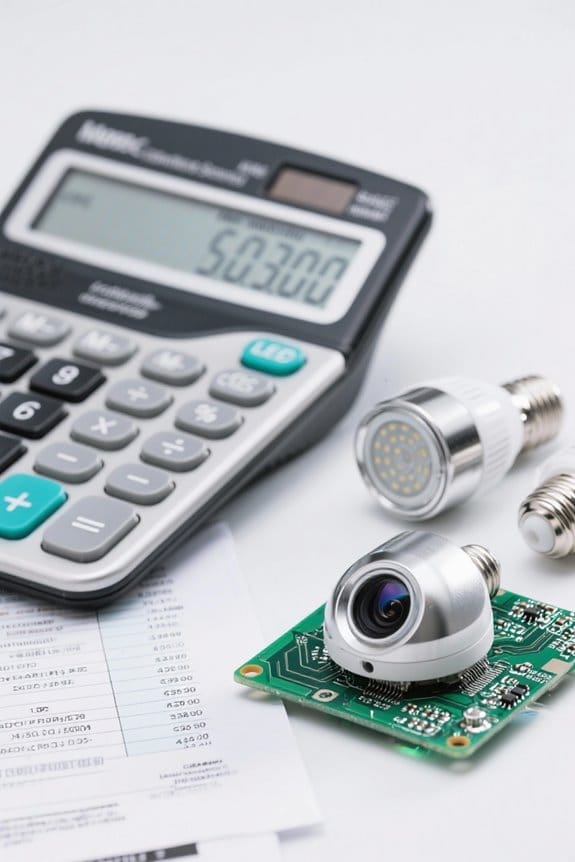
Section 1: Overview: Calculating daily and monthly electricity savings requires converting measured kWh reductions into time-based metrics, accounting for duty cycles, activation percentages, and applicable utility rates. One way to further enhance savings is by incorporating solar-powered LED path lights, which reduce reliance on traditional power sources and require minimal maintenance. 1. Daily calculation: Multiply average daily active hours by estimated kWh reduction rate, for example a sensor yielding ~1,200 kWh/year equates to about 3.3 kWh/day, multiply by $0.12 to quantify daily energy costs savings. 2. Monthly extrapolation: Sum daily savings, adjust for activation percentage, so 50% activation reduces a $25 monthly energy charge to ~$12.50, demonstrating how radar motion sensor bulbs and lighting controls help save on energy. 3. Implementation: Track usage, record duty cycles, verify monthly energy billing to confirm energy savings. Estimated payback periods can be as short as 1.2 years in high-usage areas and corridors.
Recommended Products

10-INCH SOLARMAX HD TOUCHSCREEN: Crisp, bright display viewable at extreme angles and through polarized lenses

Handcrafted in Pennsylvania by Amish craftsmen

Backyard Crafts Amish-Made Barnegat, NJ Replica Lighthouse with Solar-Powered LED Lighting, 95" Tall
Handcrafted in Pennsylvania by Amish craftsmen
Determining Installed Capacity and Load Profiles

1. Determining installed capacity requires cataloging bulb wattages and fixture counts, summing rated watts to define the system installed capacity in watts, for example a corridor with ten 10 W LED sensor bulbs equals 100 W, while retrofit with 60 W incandescent equivalents raises installed capacity to 600 W. Energy use baselines should be recorded in kWh, measured over representative intervals to reflect typical operation. 2. Evaluating load profiles involves logging activation frequency, duration, and time-of-day patterns, then segmenting into peak and off-peak intervals to model electricity use. This analysis quantifies expected saving energy and helps project how radar motion sensor bulbs will reduce energy, with ongoing monitoring advised to validate assumptions. Regular measurement refines profiles and improves predicted electricity use reductions over time. Additionally, it’s important to consider weather-resistant construction when selecting motion sensor bulbs to ensure durability and efficiency in different environmental conditions.
Estimating Payback Period and Return on Investment
2. 1) Payback period assessment: The installer calculates upfront costs per fixture, typically $20 per radar motion sensor bulbs, and estimates annual energy savings of $30, yielding a payback period of about 0.67 years in high-use locations, or approximately 1 year under conservative assumptions. The calculation accounts for reduced run-time from occupancy sensors, lower wattage of energy-efficient lighting, and expected bulb life of up to 15 years. Weather-resistant materials are recommended for any outdoor installations to ensure durability and long-term savings, as they can withstand harsh weather conditions.
2) Return on investment analysis: ROI is computed by aggregating annual energy savings, maintenance reductions, and equipment depreciation, projected over a chosen horizon, for example five years, where commercial ROI can exceed 300%, reinforcing deployment in garages, hallways, and high-occupancy zones. Implementers should document baseline consumption, monitor usage, and adjust sensor settings to optimize long-term savings regularly.
Real-world Case Studies and Example Calculations
Overview: this subsection compiles real-world case studies and example calculations, presenting measured savings, implementation parameters, sensor placement guidance, and calculable outcomes for practitioners deploying radar motion sensor bulbs. 1. Case summaries: A university study recorded average daily energy savings of 39.5 Wh/m² in underground parking and 25 Wh/m² in lecture rooms after installation, demonstrating lighting solutions benefits and reduced energy usage. 2. Building-scale impacts: Integration of radar sensors into energy management systems produced reductions up to 65.2% in campus buildings, and one underground parking retrofit achieved 77.6% total savings. 3. Example calculation: Six four-lamp F32T8 fixtures with occupancy sensors saved about 1,150 kWh annually, equal to roughly $127, useful for payback estimates. 4. Dormitory data: Daily savings reached 142.4 Wh/(m²·day), yielding 28.2% total savings. Solar-powered units assist in reducing electricity costs effectively, offering an environmentally-friendly alternative to traditional power sources.
Best Practices for Placement and Coverage
1. Placement principles: Sensors require unobstructed line of sight, mount between 8 and 10 feet to achieve ideal coverage of 20 to 40 feet, avoid walls and large furniture that impede detection, and position to minimize false triggers from passing vehicles or nearby foot traffic. Consider using passive infrared sensors for improved coverage and responsiveness in detecting movement. 2. Coverage strategy: For larger rooms employ multiple devices, align fields of view to overlap slightly, map entry and exit points, and design motion control zones to guarantee continuous lighting where occupancy occurs. 3. Installation and testing: During installation verify mounting height and angles, perform sensitivity adjustments, test coverage patterns at different times, and document settings for future tuning to support energy conservation. Regularly reassess after layout changes, and train maintenance staff on procedures and calibration intervals. annually, systematically.
Recommended Products

【Built-in 2 Outlet】The outdoor lights for house is equipped with two GFCI outlets (ground fault circuit interrupter), accommodating both two-pronged and three-pronged plugs. This setup provides convenient outdoor power access while also offering enhanced safeguards against power surges, short circuits, and other electrical issues.This outlet is suitable for various scenarios, including string lights, lawnmowers, BBQ grills, CCTV cameras, and other outdoor equipment.

Top Rated Linkable LED Utility Shop Light with Motion Sensor

CEILING OCCUPANCY SENSOR uses passive infrared technology, PIR motion sensor to automatically turn ON/OFF lights. This motion sensor features a bright LED indicator when the sensor senses motion.
Comparing Radar Sensors With PIR and Ultrasonic Options
This section compares radar, passive infrared (PIR), and ultrasonic motion sensors for lighting control, describing operational principles, detection ranges, response times, and typical installation scenarios. 1. Operational principles: Radar sensors emit microwave pulses, detecting Doppler shifts through non-metallic obstacles, PIR sensors detect infrared radiance changes within line-of-sight, ultrasonic sensors transmit high-frequency sound and measure echo variations. 2. Performance metrics: Radar sensors typically detect 0.1 m/s motion at 10–20 m range, PIR sensors cover 5–15 m with 0.3 m/s thresholds, ultrasonic sensors reach 3–6 m but consume more power. 3. Practical guidance: For high-traffic corridors choose radar for faster response and higher accuracy, for enclosed rooms select PIR for low energy use, use ultrasonic only where micro-movement sensitivity is essential. Expected savings depend on deployment. Solar lights are an environmentally friendly option as they operate independently of electrical wiring and do not contribute to electricity costs.
Recommended Products

【Based on ROS Programmable Project Professional Kit】using rviz, TF, QT, navigation and other tools, combined with lidar and depth camera, transbot realizes 2D3D mapping navigation, path planning and other functions, learns ROS from scratch, and journey of ROS programming with Transbot.(★Note: check the version you ordered carefully)

[ Black Wall Hung Smart Toilet Combo ]: SmartSylva New Smart Wall Hung ToiletCombo comes with a Smart Wall Hung Toilet and an In-Wall Carrier. It includes a Built-in Bidet and a large capacity Built-in Water Tank, features the intelligent functions as :Heated Seat ,Instant Warm Water, Hygienic Washing, Warm-Dryer, Auto Open/CloseLid, Foot Sensor Open/Close Lid and Seat, Auto Flush, Foot Sensor Flush,LED TEMPDisplay, Nightlight and Remote Control.The special Black Color make it stylish in yourbathroom.

More 4K coverage and light where you need it —With 3 Floodlight Cam Pro, Wired (2nd Gen), White, expand 4K protection and illumination to more areas on your property.
Maintenance, Lifespan, and Performance Degradation
Inspect radar motion sensor bulbs at regular intervals, cleaning lenses, checking for obstructions, and verifying sensitivity settings to maintain 15,000–30,000 hours of service. 1. Maintenance: Follow manufacturer schedules for cleaning every three to six months, use a soft cloth and isopropyl wipe, inspect seals and connectors to prevent moisture ingress. 2. Lifespan and replacement: Expect a lifespan of 15,000 to 30,000 hours, monitor cumulative run time and replace before lumen output drops below seventy percent to avoid reduced illumination. 3. Performance degradation: Calibration drift and environmental changes cause false triggers and increased standby draw, adjust sensitivity and reposition fixtures as needed. 4. Energy and money impacts: Proper upkeep guarantees sensors save electricity and money, preserving ideal performance and long term savings. Replace per schedule. Solar-powered outdoor lights, such as those with motion detection capabilities, also provide energy efficiency and can enhance security around outdoor areas.
Environmental Benefits and Carbon Emission Reductions
Although often overlooked, radar motion sensor bulbs reduce unnecessary lighting, permitting electricity savings up to 90% in intermittently used spaces. 1. Emissions impact: By minimizing run-time, radar motion sensors lower electricity demand, reducing carbon emissions tied to grid generation, estimates show a 40–60% reduction in lighting-related emissions in optimized buildings. 2. Implementation metrics: Install sensors in corridors, restrooms, and conference rooms, program 30–300 second vacancy timeouts, pair with energy-efficient lighting such as LEDs which use at least 75% less power, and quantify savings in kWh and CO2e annually. 3. Institutional benefits: Compliance with efficiency regulations improves sustainability reporting and reduces operational costs. Proper commissioning and periodic verification guarantee projected savings are realized. Monitoring systems provide actionable data for maintenance, benchmarking, and continual performance improvement.
Frequently Asked Questions
Do Motion Sensor Light Bulbs Save Electricity?
Yes. They improve energy efficiency as smart lighting by switching lights only when needed, extending bulb lifespan, altering usage patterns, producing measurable cost savings, and reducing environmental impact through lower consumption and fewer replacement cycles.
Do Motion Sensors Use a Lot of Electricity?
No — motion sensors do not use a lot of electricity; their sensor efficiency keeps energy consumption minimal, yielding cost savings, offering installation benefits, adapting to usage patterns, and improving with technology advancements over time reliably.
Are Outdoor Sensor Lights Expensive to Run?
Modest monthly They are inexpensive to operate: outdoor lighting offers strong energy efficiency; a cost comparison favors LEDs considering bulb lifespan, modest installation expenses, and clear long term savings despite occasional replacement needs over time
Are Motion Sensor Light Bulbs Worth It?
They are worth it. The motion sensor benefits include improved energy efficiency, enhanced security features, and a strong convenience factor; a reasonable installation process and careful cost analysis usually show fast payback and lasting savings.


