As an Amazon Associate, we earn from qualifying purchases. Some links on this site are affiliate links at no extra cost to you. Our recommendations are based on thorough research and editorial judgment.

How LED Drivers and Sensors Work Together in Smart Bulbs

1. The driver: converts 120 V AC to a regulated 350–700 mA constant-current output, supplies 12–36 V to LEDs, manages PWM or 0–10 V dimming, and enforces thermal shutdown at 85–110°C. 2. The sensors: PIR detects occupancy at 3–8 m, ambient sensors measure 0–1000 lx, and fusion logic issues occupancy and lux flags. 3. Integration: MCU interprets flags within 50–200 ms to adjust brightness and color. More components are explained.
Key Takeaways
- LED drivers supply regulated constant-current power while interpreting sensor signals to modulate brightness and color for stable LED performance.
- Motion and ambient sensors send occupancy and lux data to the microcontroller, triggering driver-driven on/off and dimming decisions.
- Communication occurs via MCU interfaces (PWM, 0–10V, UART, I2C, Zigbee/BLE) translating sensor inputs into driver control commands.
- Drivers implement thermal protection and current limiting, adjusting output or shutting down when sensors or temperature thresholds indicate overload.
- Combined sensor-driver control enables automated scenes, energy savings, and flicker-free transitions using fast response times (50–200 ms).
What Makes a Smart Bulb Smart?

1. Smart bulbs are defined by integration of LED arrays, microcontrollers, wireless connectivity and sensors, enabling programmability and remote control. 2. Core components include RGB and dedicated white LEDs rated for 800–1100 lumens, microcontroller units managing color and brightness, and RF modules supporting Wi‑Fi, Zigbee or Bluetooth for mesh or direct connections. 3. Energy efficiency is achieved through LED technology drawing 9–12 watts versus 60‑watt incandescent equivalents, reducing consumption by approximately 80%. 4. Functional features include color‑changing, scheduled scenes, and occupancy sensing, implemented via ambient and motion sensors. 5. User interfaces include mobile apps and voice integration, offering adjustable brightness in 1% increments, timing schedules, and centralized device grouping for coordinated control. This configuration permits firmware updates over the network, enhancing longevity and security. 6. Many smart bulbs now come with dimming capabilities, allowing users to customize the ambiance and illumination levels in their spaces.
Recommended Products

WOOD SAUNA DURABLE DESIGN: Experience the beauty and durability of wooden Okoume in our 2 person far infrared sauna. Dry sauna for home size: (47.3*41.3*74.8 IN). Its high resistance to moisture and decay ensures long-lasting use, while the tempered glass door provides enhanced safety and temperature tolerance. This indoor sauna 2 person is a sophisticated addition to any home spa.

(3D Water Vapor Fireplace, Realistic Flame & Dual Heating): This premium steam fireplace features dimmable lifelike flames and optional crackling fire effects. It is smokeless, ash-free and flameless, equipped with 650W/1300W dual heating modes. The fanless natural airflow delivers gentle warmth without drying out indoor air.
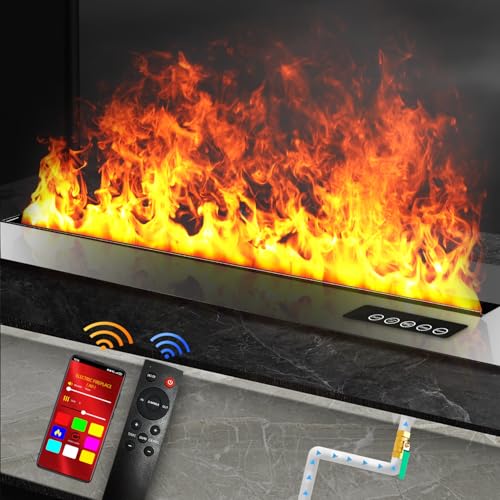
ADVANCED 3D MIST FLAME TECHNOLOGY WITH ZERO HEAT OUTPUT: The atomizer of water vapor fireplace has undergone 30000 hours of testing. The flame effect achieves remarkable realism through advanced 3D mist technology. The movement is dynamically natural, with flickering, swaying, merging, and dissipating flames that mimic the genuine randomness of a real fire. Exquisite details are featured, including glowing embers at the base, subtly rising sparks, and semi-transparent flame tips, all enhancing the immersive experience.
Role of the LED Driver in Smart Bulbs
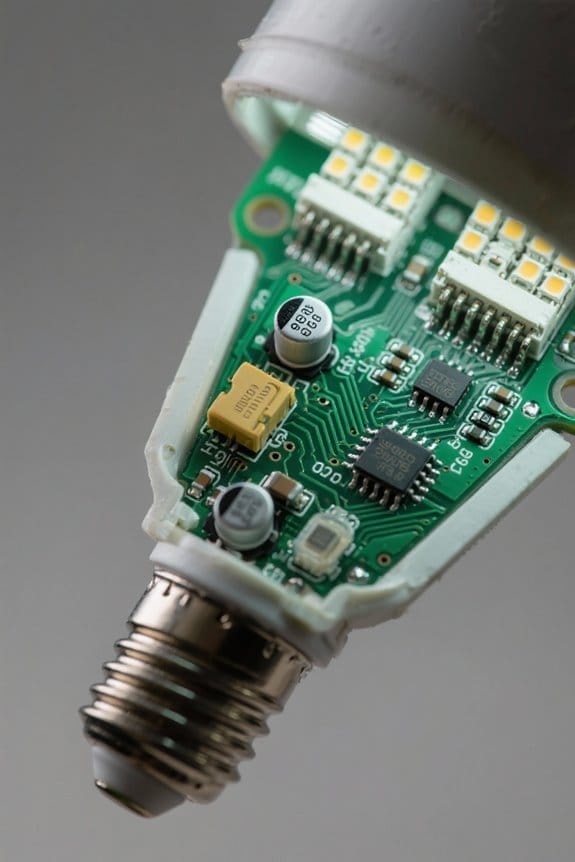
Overview: The LED driver is the power-management module that regulates voltage and current to LED arrays, providing stable, efficient illumination and enabling smart functionality through controlled dimming, color mixing, and sensor-driven adjustments.
- Function: The LED driver converts 120 V AC or 24 V DC inputs to regulated 350–700 mA output, maintaining forward voltage for LEDs, ensuring energy efficiency and longevity.
- Features: In smart bulbs the driver provides dimming control, brightness and color modulation, wireless interfaces for app or hub commands, and compatibility with 0–10 V or PWM systems.
- Interaction: It receives data from sensors and firmware, adjusts power management in milliseconds to achieve energy savings without flicker, and supports remote automation.
- Implementation: Use certified drivers, thermal management, and surge protection. Proper implementation of sensor technology features can enhance energy efficiency by activating lights based on necessity, reducing unnecessary power consumption.
How Motion and Ambient Sensors Detect Activity

- Motion detection: Passive infrared motion sensors in smart bulbs detect body heat changes within typical ranges of 3–8 meters, with response times of 0.5–2 seconds, triggering LED lighting systems only when occupancy is present.
- Ambient sensing: Ambient sensors measure illuminance in lux, commonly calibrated between 0–1000 lx, and adjust output to maintain target levels, reducing lumen output during daylight.
- Combined operation: When both sensors are integrated, bulbs enable automating lighting by activating only under low ambient light and confirmed motion, improving energy savings in residential and commercial spaces.
- Implementation notes: For reliable lighting control, install at 2–3 meters height, avoid direct sunlight on sensors, and set timeout intervals to balance convenience and savings. Consider using LED lights which provide longevity with around 50,000 hours lifespan, ensuring durability and energy efficiency for smart bulb applications.
This enhances user convenience overall.
Recommended Products

Intelligent lighting in multiple formats. Adapts and transforms with your day.

Intelligent lighting in multiple formats. Adapts and transforms with your day.

WHAT’S IN THE BOX - Includes two black Hue Discover outdoor color-changing flood lights; Perfect for garages, back doors, and more.
Communication Between Sensors and Drivers

Reliable communication between motion and ambient sensors and LED drivers is essential for automated lighting control, and it depends on clearly defined interfaces, compatible voltage and current levels, signal timing, and appropriate cabling or wireless protocols. 1. Interface standards: typical links include 3.3V UART or I2C buses, 0–10V analogue dimming, and PWM at 1–2 kHz, each carrying commands that adjust output power in 1% steps, enabling precise dimming. 2. Signal design: motion sensors send occupancy flags and time stamps, drivers interpret messages within 50–200 ms latency budgets, and automatic on/off functions are triggered when thresholds are exceeded. 3. Implementation: smart bulbs use shielded cables or BLE/Zigbee, ensuring energy-efficient lighting and tailored lighting experiences. Designers should validate signal integrity with oscilloscopes and error rates under 10−6. When selecting smart bulbs, it’s important to ensure compatibility with existing smart home technology, as this enhances the integration and functionality of the lighting system.
Power Management and Thermal Protection in Drivers

1. Power management in LED drivers is tasked with regulating current and voltage, supplying 350–700 mA at 12–36 V, to maintain stable light output and prevent overheating of LED junctions. 2. Thermal protection implements monitoring and control, using temperature sensors near the LED board, with shutdown thresholds commonly set between 85°C and 110°C to avoid thermal runaway. 3. Implementation examples include constant-current drivers with PWM or analog dimming capabilities, which reduce RMS current to lower junction temperature and improve energy efficiency, thereby extending lifespan. 4. Practical considerations cover heat sinking, thermal coupling, and firmware hysteresis to prevent oscillation, ensuring reliable operation, predictable maintenance intervals, and safe deployment in smart bulbs. Designers should specify derating curves, 80% at 50°C, and document test methods and certifications.
Dimming, Color Tuning, and Scene Control Enabled by Drivers and Sensors
Adaptive control of light output in smart bulbs combines precise current regulation, spectral adjustment, and scene logic, enabling programmable brightness, correlated color temperature, and automated responses tied to sensors and user interfaces. 1. Dimming: LED drivers provide smooth dimming from 0% to 100%, using constant current reduction, PWM at 1–2 kHz or analog control, yielding lumen scaling and enabling energy efficiency, for example reducing power from 10 W to 1 W when dimmed to 10%. 2. Color tuning: Intelligent drivers adjust multi-channel currents to shift CCT between 2700 K and 6500 K, balancing CRI and chromaticity coordinates, implemented via calibrated lookup tables. 3. Scene control: Pre-set scenes stored in drivers, triggered by motion sensors or mobile app interfaces, allow switching, schedules, and grouped commands. Solar lights, such as TECKNET LED Solar Lights, utilize efficient technology to convert sunlight into electricity, ensuring long-lasting illumination despite varying weather conditions.
Recommended Products

𝐒𝐨𝐥𝐢𝐝 𝐁𝐫𝐚𝐬𝐬 & 𝐀𝐥𝐥-𝐖𝐞𝐚𝐭𝐡𝐞𝐫 𝐑𝐞𝐚𝐝𝐲: Premium solid brass construction ensures no rust or fading over time. IP65 waterproof and engineered to withstand -40°F to 104°F. Keeps your garden beautifully illuminated through heavy rain, snow, or intense sun
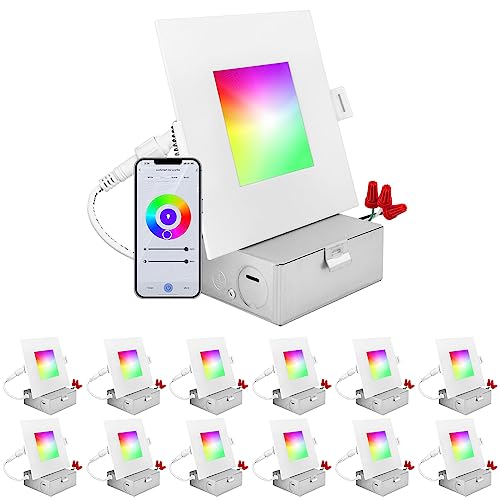
RGBW ADJUSTABLE - Immerse yourself in a world of captivating colors with smart recessed lighting that has a stunning range of 16 million colors and tunable white light between 2000K-5000K. Adjust the hue of these RGB lights for a personalized touch when you are watching movies, playing games, hanging out with friends, or just relaxing at home. You can even dim down to your preferred setting when you need to give your eyes a rest. Be in control of your home from anywhere with these smart lights.

SMART: Colorscaping is a state-of-the-art fully tunable landscape lighting system where each luminaire can be individually controlled or grouped from the myWAC iOS or Android App.
Troubleshooting Compatibility and Common Issues
Several compatibility failures occur when LED drivers supply incorrect voltage or current, causing flicker, overheating, or premature lumen depreciation in smart bulbs. 1. Assessment: Verify driver output 12–24 V DC or 120–277 V AC ratings match bulb specifications, confirm current limits (350–700 mA), test dimming protocol compatibility such as PWM or 0–10 V, and log electromagnetic interference levels with a spectrum analyzer. 2. Common faults: Generic drivers often cause performance problems, flicker, or inability to dim correctly, and power surge events above 1.5 kV can damage components. 3. Troubleshooting steps: Isolate circuits, replace suspect drivers with programmable units, retest with surge protection rated at 600–1,000 V, and perform EMI mitigation using ferrite cores. Maintain records. Battery-operated motion lights, which are rated IP65 waterproof, can withstand outdoor elements and serve as an efficient lighting solution for various spaces. Assurance: systematic testing prevents failures and guarantees long-term reliability.
Recommended Products

Now includes AGS (Auto Generator Start) | MPPT Tracking | True paralleling - Inputs and Outputs for two KIDs | Up to 150V input
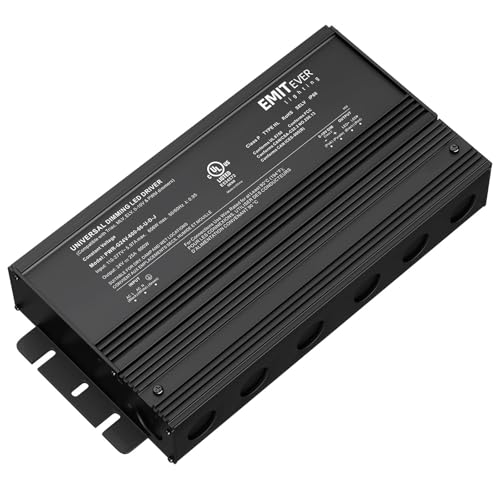
5-in-1 Forward and Reverse Phase Dimming: ELV / MLV / TRIAC / 0-10V / 1-10V / 10V PWM / Potentiometer.Versatile driver for most high-performance dimming applications: The Adaptive Pro 5-in-1 dimmable Class 2 drivers are designed to operate with any standard MLV / ELV / Incandescent TRIAC (forward phase) dimmer switch or can also be used with secondary side controls systems. Used commonly with Lutron and Leviton receivers and controls for secondary side dimming.
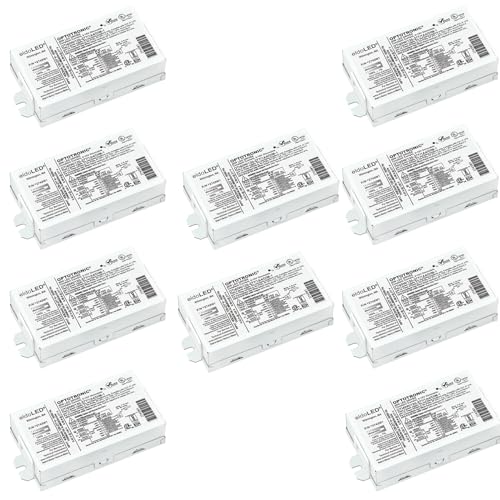
Universal input voltage - 120–277VAC 50/60Hz
Frequently Asked Questions
How Do LED Light Drivers Work?
They convert AC to DC, providing power supply regulation that guarantees LED efficiency through voltage regulation and current control; driver types differ in circuit design, include dimming capabilities, and employ thermal management for long-term reliability.
Does Each LED Light Need Its Own Driver?
Not necessarily; like a conductor, single driver can power LEDs. LED driver types, Driver compatibility, Power supply considerations, Circuit configuration options affect LED lighting efficiency, Smart bulb functionality, Heat management strategies and Energy saving benefits.
How Do LED Sensors Work?
They use motion sensing capabilities and ambient light detection, applying dimming functionalities and color temperature adjustment to optimize LED light performance, enable energy efficiency improvements, and connect via wireless communication features to automated lighting systems.
How Many LEDS Can You Run With a Driver?
Measure twice, cut once. They determine number by dividing power supply voltage by LED forward voltage, observing LED driver limits and driver specifications; consider LED efficiency, circuit design, parallel connections, PWM control, proper thermal management.


