As an Amazon Associate, we earn from qualifying purchases. Some links on this site are affiliate links at no extra cost to you. Our recommendations are based on thorough research and editorial judgment.
How Lumens, Beam Angle and CCT Affect Outdoor Motion Lighting

1) Lumens define total light output, specify 100 lm/ft² for general areas, 200 lm/ft² for paths, 500–1000 lm for security, calculate using target lux and inverse-square falloff. 2) Beam angle controls spread and candela, use 12°–24° for spot highlighting, 50°–65° for area wash, match to mounting height. 3) CCT affects contrast and ecology, choose 2700–3000K for residential comfort, 4000–5000K for detection tasks. Additional setup, sensor tuning, dimming, maintenance guidance follow.
Key Takeaways
- Lumens determine total light output and required brightness per area (e.g., ~100 lm/ft² general, 200 lm/ft² pathways).
- Beam angle controls spread and intensity: narrow (~12–30°) concentrates lux, wide (>50°) covers larger areas with lower illuminance.
- CCT affects visibility, glare, and ecology: 2700–3000K for comfort, 4000–5000K for improved detection and deterrence.
- Match lumen output and beam angle to mounting height using inverse-square behavior: narrow beams for >10 ft, wider angles for low mounts.
- Combine motion-triggered high output with dimming/timers to balance security, reduce false triggers, and conserve energy.
Understanding Lumens and Brightness Levels
1. Understanding lumens and brightness levels: This section defines lumens and explains their role in outdoor motion lighting applications, providing target values for various spaces. 2. Measurement and application: Lumens measure total visible light output, higher lumen counts mean brighter scenes, recommended values include about 100 lumens per square foot for general outdoor areas, 200 lumens per square foot for pathways, pathway fixtures commonly range 100–300 lumens, security fixtures may require 500–1000 lumens. 3. Efficiency and selection: LEDs provide high lumens per watt, typically 80–150 lm/W, enabling specified light output with lower energy use. 4. Implementation guidance: Match fixture light output to area size and task, consider fixture design to minimize light pollution, and verify installed output against targets. Adjust settings for consistent coverage. Low voltage lights, often used for pathways, offer significant energy savings compared to traditional options while maintaining optimal brightness levels.
How Beam Angle Controls Coverage and Intensity
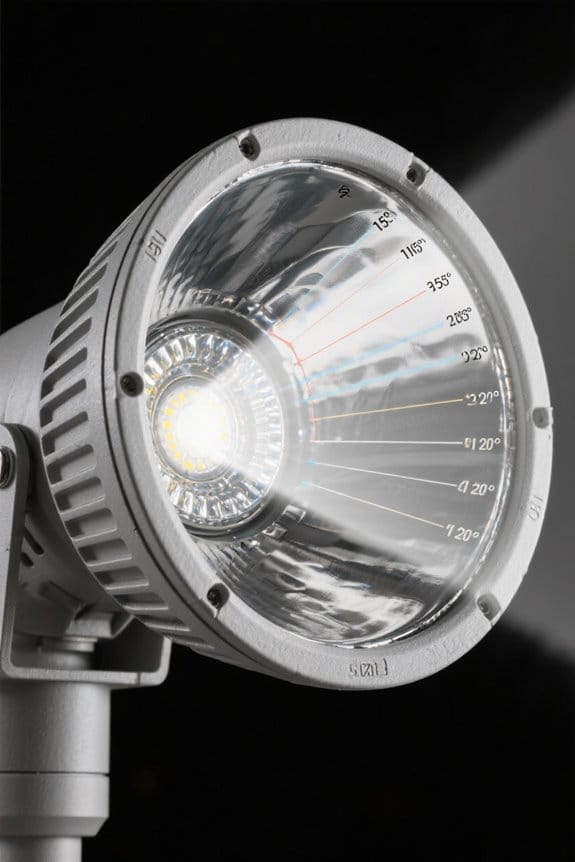
Beam angle determines the angular spread of emitted light, and therefore directly controls coverage width, illumination intensity, and the likelihood of creating hot spots or dark gaps, making it the primary optical parameter to specify when designing outdoor motion lighting layouts.
- Selection criteria: Beam angles govern concentration and dispersion, with narrow beam choices (12–24 degrees) producing intense focal illuminance for targets, while wider beam selections (50–65 degrees) distribute lumens over larger areas, yielding lower lux values per unit area, beneficial for landscape lighting.
- Applications: A narrow beam is recommended for sculptures, trees, and accenting architectural details, providing targeted highlight without overspill.
- Design guidance: Use overlapping wide coverage patterns to minimize dark spots, and compute lux falloff to guarantee surveillance and security efficacy.
Adding motion sensor lights with PIR range capabilities can enhance security by detecting movement within a specified distance, ensuring that the lighting adjusts appropriately to activity.
Choosing CCT for Safety and Ambience
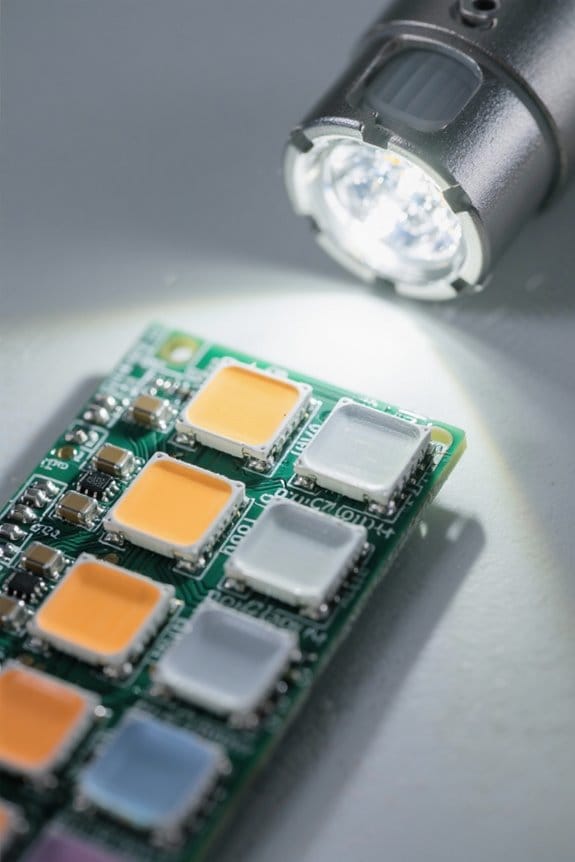
A wall-mounted floodlight with adjustable color temperature can simultaneously influence visibility, perceived safety, and ecological impact, so careful CCT selection is essential when specifying outdoor motion lighting for any site. 1. Recommendations: Select 2700K–3000K for residential ambient comfort, 3000K as a compromise between glare reduction and safety, and 4000K–5000K when enhanced detection and deterrence are primary objectives. 2. Safety considerations: Higher CCT above 4000K increases short‑wavelength content, improves contrast and object recognition at night, and can deter unwanted activity, but may increase glare. 3. Environmental impact: Limit use of CCT above 3000K near sensitive habitats, implement shielding and motion activation to reduce wildlife disruption. 4. Implementation: Specify adjustable CCT fixtures, test on site, and document final settings. Include measured lux targets and occupant feedback. Motion sensor lights with dimmable LED compatibility offer flexible control over brightness, allowing users to adjust illumination based on specific needs and environmental conditions.
Matching Lumens and Beam Angle to Mounting Height
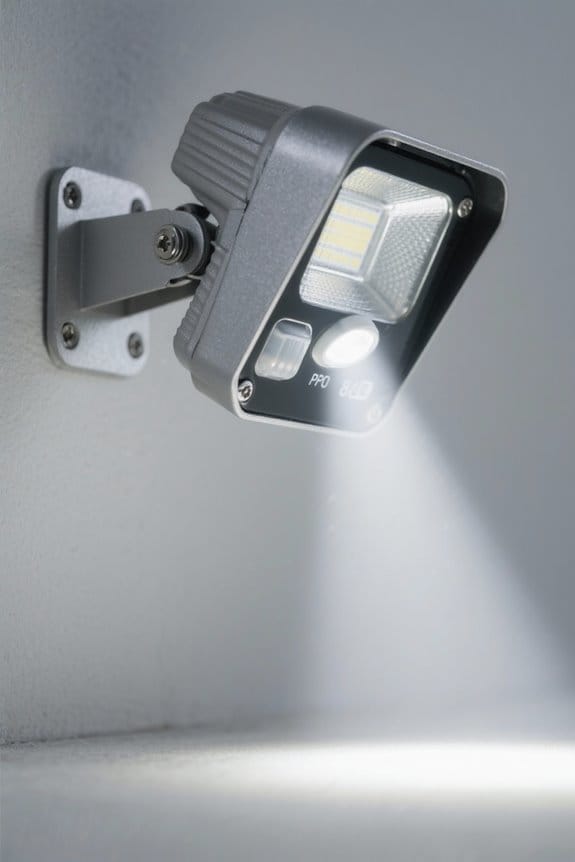
When specifying lumen output and beam angle for outdoor motion lighting, designers must account for mounting height, target lux, beamspread, and mounting geometry, since these variables interact through inverse‑square falloff and candela distribution to determine on‑surface illuminance and object contrast. 1. Assessment: Calculate required lumens from target lux and area, using roughly 100–200 lumens per square foot depending on risk level, adjust for mounting height by applying inverse‑square law and fixture efficiency. 2. Beam selection: Choose narrower beam angle (≤30°) for heights above 10 feet to concentrate candela, select wider angles (>60°) for lower mounts to avoid gaps. 3. Implementation: Model candela distribution, verify illuminance at task plane, and select fixtures that balance lumen rating with beam angle. Confirm performance with on‑site measurements. Solar motion detection lights typically have IP65-IP68 weatherproofing, ensuring they can withstand various outdoor conditions while maintaining efficiency.
Motion Sensor Integration and Triggered Brightness
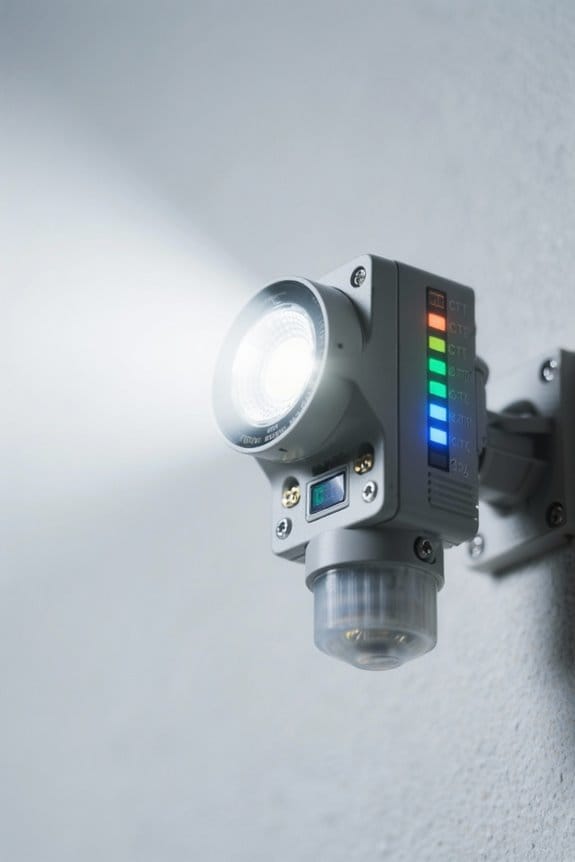
1. Detection range and settings: Motion sensors commonly detect movement between 20 and 100 feet, sensitivity is adjustable to reduce false triggers in high-traffic zones, and time delay is programmable from about 10 seconds to several minutes. 2. Triggered brightness selection: Choose lumens output based on targeted area size and desired visibility, higher lumens for large zones, lower for pathways; pair with appropriate beam angle, narrow for focused spots, wide for area wash. 3. Integration guidelines: Use LED fixtures designed for sensor control, verify sensor range aligns with mounting height and coverage patterns, test in situ for false positives and sufficient post-trigger illumination. 4. Operational note: Document settings, reassure users on predictable behavior. Adjust parameters seasonally and record results regularly to refine system performance. Many modern security lights offer weather resistance with IP65 or IP66 ratings, ensuring they function reliably in various environmental conditions.
Energy Efficiency and Lumens-per-Watt Considerations
Overview: Energy efficiency for outdoor motion lighting centers on optimizing lumens-per-watt (lm/W), matching lumen output to target area, and deploying controls that reduce run-time and peak power, with typical guidance of 100 lumens per square foot for general areas and up to 200 lumens per square foot for focused pathways.
- Performance metrics: Evaluate fixtures by lm/W, aiming for 100–150 lm/W in high-performance models, because higher lumens per watt reduce energy consumption and fixture count.
- Fixture selection: Choose LED technology offering 50–80% greater energy efficiency than traditional sources, balance total lumens versus beam distribution, and size output to minimize overlap.
- Controls and savings: Integrate motion sensors, dimming, and scheduling to cut run-time, these strategies yield measurable reductions in kilowatt-hours and operating cost. Waterproof design ratings ensure that the fixtures function efficiently in diverse climates, adding durability and resilience to outdoor motion lighting solutions.
Minimizing Glare and Light Pollution With CCT and Optics
Effective outdoor motion lighting minimizes glare and light pollution by combining low correlated color temperature (CCT), precision optics, and shielding, each configured to meet specific site requirements and regulatory benchmarks. 1. CCT selection: Choose ≤3000K to reduce blue spectral content, decrease skyglow, and limit biological impact, providing comfortable color rendering for pedestrian zones. 2. Optics design: Specify narrow beam angles and asymmetric lenses, aiming for 10–25 degree cutoff and uniform horizontal illuminance, to concentrate light on pathways while avoiding uplight. 3. Shielding and aiming: Use full cutoff fixtures, adjust mounting height to 2–4 meters, and set tilt to zero degrees, minimizing glare and reducing light pollution. 4. Integration: Combine lower CCT and optics to improve safety and preserve night sky visibility effectively. For decorative solar path lights, weatherproof durability is crucial to ensure they function efficiently in various environmental conditions.
Installation Best Practices for Outdoor Motion Lights
One essential focus for installation is precise placement and sensor alignment, which determine detection coverage, false-trigger rates, and overall system effectiveness. 1. Mounting height and coverage: Position fixtures at 7–10 feet to maximize detection range and cover entry points and driveways, consider beam angle to shape illumination and overlap adjacent zones. 2. Sensor line-of-sight and sensitivity: Guarantee the motion sensor has an unobstructed field of view, trim foliage and avoid walls, adjust sensitivity to reduce animal and vehicle triggers. 3. Testing and verification: Conduct dusk test runs to confirm activation across conditions, reposition if dead zones or spill occur. 4. Practical maintenance note: Clean lenses and remove debris regularly to preserve sensor performance, maintaining consistent reliability. To ensure optimal security coverage, consider using high-sensitivity PIR sensors which provide extensive detection ranges and enhance the effectiveness of outdoor lights. Follow these installation best practices for dependable operation.
Maintenance, Dimming and Smart Control Options
1. Routine maintenance: clean lenses monthly, remove debris and use a soft cloth with isopropyl alcohol to prevent dirt that can reduce lumen output by up to 30%, inspect seals and replace gaskets rated IP65 if compromised. 2. Dimming options: install a compatible 0–10V dimmer or PWM driver to reduce output during low-traffic hours to 30–50% lumen levels, which conserves energy and extends LED life. 3. Smart control: integrate timers, photocells, and app-enabled smart control hubs to schedule operation, enable remote access, and provide telemetry on runtime and power consumption. 4. Sensors and tuning: set motion sensitivity and hold times, use 120–240° beam placement and 5–15 minute timeout to minimize false triggers. Follow manufacturer torque specs, 4–6 Nm, and record service dates for performance.
Frequently Asked Questions
How Many Lumens for Outdoor Motion Light?
700–1,200 lumens. It waits, then clarifies that this range balances outdoor safety, lighting efficiency and motion detection; pathways may use 100–200 lumens, driveways 500–1,000, ensuring clear visibility and deterrence for night coverage and sensor response.
How Will Beam Angle Affect Home Lighting?
Beam angle determines coverage and contrast, guiding spotlight placement to highlight features, balancing outdoor safety with glare control, widening or narrowing scenes to shape lighting aesthetics and guarantee paths, entries, and focal points remain visible.
What Is the Best Beam Angle for LED Lights?
A 24–38° beam angle is typically best for general outdoor motion lighting, balancing focused visibility and coverage. Designers consider beam angle variations, ideal lighting distance, and specific outdoor fixture types for correct placement and intensity.
Is 5000 Lumens Bright for Outdoor Lights?
Yes, like a lighthouse at midnight, it overwhelms surroundings; in brightness comparison it ranks very high, offering excellent outdoor visibility, though lumen efficiency and beam angle determine effective coverage and glare control for security use.


