As an Amazon Associate, we earn from qualifying purchases. Some links on this site are affiliate links at no extra cost to you. Our recommendations are based on thorough research and editorial judgment.

Balancing Security and Privacy With Directional Motion Lights

1. Privacy: Position screens and fixtures to limit sightlines, mount motion lights at 1.8–3.0 m, use warm LEDs, and select beam angles under 60° to reduce spill. 2. Security: Specify 400–800 lumen fixtures, sensor range 0.5–10 m, PIR or microwave detection, and IP65 rated housings for reliable operation. 3. Placement: Combine 1–2 m setbacks, directional optics, and adjustable sensitivity to protect private areas. More guidance follows for implementation and maintenance. Step-by-step examples and troubleshooting included.
Key Takeaways
- Mount directional motion lights 6–10 feet high and aim them at entryways and paths to illuminate targets while avoiding neighbor sightlines.
- Use 400–800 lumen fixtures with narrow optics and warm-toned LEDs to reduce spill light and preserve privacy.
- Configure PIR or microwave sensors for appropriate sensitivity and 0.5–10 meter range to minimize false triggers and unwanted illumination.
- Integrate landscaping screens, fences, or 1–2 meter setbacks to block backlighting and maintain secluded outdoor areas.
- Schedule quarterly inspections and document detection settings to ensure reliable performance without compromising privacy.
Why Privacy Matters in Outdoor Spaces
1. 1.1 Purpose: Privacy in outdoor spaces enhances relaxation and enjoyment, and it directly supports security by reducing visibility and unwanted observation, thus outdoor lighting design must balance concealment with visibility and safety. 1.2 Implementation: Use landscaping features such as hedges 6–8 ft (1.8–2.4 m) tall, solid fences 6 ft (1.8 m), and berms 0.5–1.0 m high to create visual screens, combined with strategic lighting placed at 0.5–1.0 m above grade to enhance pathways without backlighting private areas. 1.3 Guidance: Orient fixtures to cast downward beams of 15–30 degrees, select cutoff lenses to prevent glare, and place controls on timers or motion-sensitive zones to preserve outdoor living privacy while maintaining overall security. Maintain setback distances, typically 1–2 m, between paths and screens for comfort. Consider using energy-efficient lighting options like LED bulbs to further enhance sustainability and reduce electricity costs while maintaining privacy.
How Directional Motion Lights Improve Security
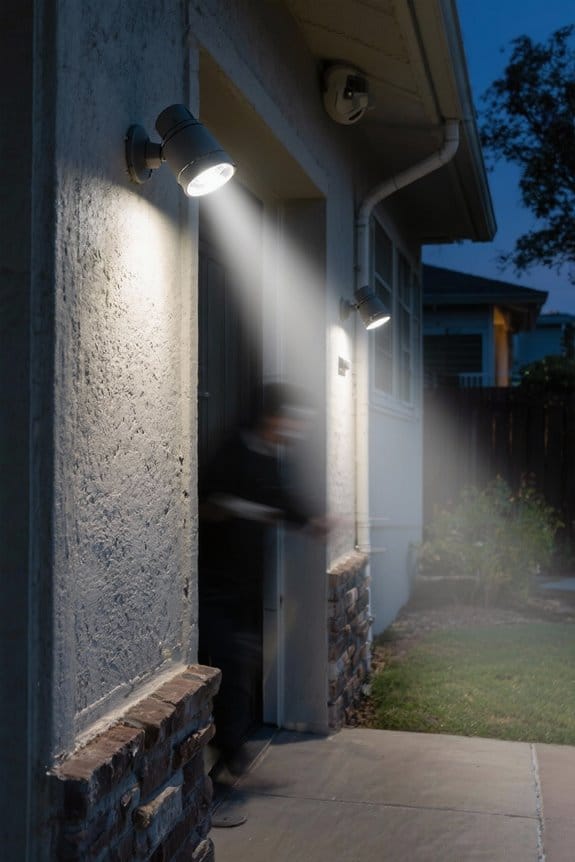
Directional motion lights improve security by focusing illumination on targeted zones such as entryways, driveways, and pathway segments, to enhance visibility and reduce concealment. 1. Targeted coverage: Install fixtures to illuminate 10 to 15 foot approach zones with 400 to 800 lumens per fixture, mounted 8 to 10 feet high, beam angles set to 60 to 90 degrees to eliminate dark zones and cover key areas without excessive spillage. 2. Sensor integration: Motion sensors trigger immediate lighting within 0.5 to 10 meters, creating sudden illumination that can startle intruders and alert occupants, while enabling integration with monitoring systems for real-time response. 3. Privacy preservation: Directional motion lights reduce glare and light trespass by shielding beams, maintaining property privacy yet providing effective lighting solutions for safety and security. Additionally, the IP65 or IP68 ratings of these lights ensure superior weather resistance, making them reliable even in harsh conditions.
Choosing the Right Motion Sensor and Fixture

When choosing motion sensors and fixtures for outdoor security lighting, the installer should evaluate sensor technology, fixture optics, and mounting geometry to balance detection reliability, illumination effectiveness, and neighbor privacy. 1. Sensor selection: choose PIR for body-heat sensitivity or microwave for broader range, mount sensors 6 to 10 feet high, angle toward targets to reduce false triggers, confirm detection cone and sensitivity. 2. Fixture specification: select lighting fixtures with directional lighting, adjustable brightness, and high CRI to aid recognition, specify color temperature to avoid glare and preserve privacy. 3. Integration and commissioning: coordinate sensor lens, fixture optics, and proper placement, test detection zones and dimming levels, document settings for consistent enhancing security while respecting privacy. Provide calibrated diagrams and maintenance schedules for operational reliability. Consider selecting energy-efficient lighting solutions to reduce energy consumption and operational costs while maintaining high performance and longevity.
Strategic Placement for Privacy-Friendly Illumination

A systematic approach links sensor selection and fixture commissioning from the previous section to the strategic placement of motion lights, ensuring that detection geometry, mounting height, and optical aim work together to protect priority zones while minimizing spill light into adjacent private areas. 1. Site assessment: map entryways, pathways, and outdoor spaces, note sightlines and neighbor windows, mark priority zones for lighting, privacy. 2. Mounting and aim: install motion lights at 6 to 10 feet to maximize sensor range and focused illumination, adjust optical aim to avoid spill light into adjacent yards. 3. Fixture choice and ambient lighting: select warm-toned LEDs and directional optics for subtle but effective illumination. 4. Landscaping integration: use shrubs and trellises to shield sensors, maintain security while preserving privacy. When selecting motion sensor garage lights, it is crucial to consider sensor features and detection capabilities, such as adjustable sensitivity settings and pet-immune sensors, to ensure that activations are accurate and reduce false alarms.
Design Techniques to Soften Light and Reduce Glare

1. Lighting types and softening strategy specifies fixture selection and placement to reduce glare and enhance privacy in outdoor installations, recommending warm color temperatures of 2700–3000K and lumen outputs between 200–800 lm for pathway and task lighting. 2. Indirect methods: use wall-mounted uplights and shields that bounce light off surfaces at angles of 30–60 degrees, creating soft lighting, lowering direct glare by 50%, and producing an inviting atmosphere. 3. Directional lighting: employ narrow beam (15–30°) for focal tasks and wide beam (60–120°) for general diffusion, mount fixtures at varied heights of 0.6–2.4 meters to diffuse changes, and add dimmer control for adjustable intensity. 4. Architectural features integrate baffles and louvers to control spill light. Specify IP65 rated fixtures for durability and safety. 5. In selecting solar motion security lights, prioritize high-efficiency solar panels paired with lithium-ion batteries for sustainable and reliable outdoor lighting solutions.
Maintenance and Troubleshooting for Reliable Performance
Section 1: Routine inspection and cleaning: maintenance personnel should perform visual inspections every three months, or monthly in coastal, dusty, or heavily vegetated sites, to verify lens clarity, sensor aperture cleanliness, and mounting integrity, using a 10x loupe for optical inspection and noting any scratches, moisture ingress, or corrosion around IP65-rated housings. 1) Testing and adjustment: technicians should perform functional tests to verify motion sensor lights detect movement within specified ranges, adjust sensitivity to reduce false activations, and confirm coverage of specific areas, using calibrated motion targets at 1.5 meters and 5 meters. 2) Power and components: inspect power supplies, connections, and replace bulbs on schedule, select the right fixtures for outdoor space mounting, and document results to guarantee reliable performance. Maintain troubleshooting logs. For optimal performance, ensure solar panels should be oriented south at a 20-35° tilt to maximize sun exposure and efficiency.
Frequently Asked Questions
Do Motion Lights Deter Burglars?
Yes; like a lighthouse, they often deter burglars. Motion light effectiveness, Lighting placement strategies, Home security enhancements, Burglary prevention techniques, Outdoor lighting options, Safety perception impact, Crime rate correlation, Neighborhood watch programs, Smart technology integration.
What Are the Disadvantages of Motion Sensor Lights?
They suffer false alarms, limited range, and sensor sensitivity problems; weather effects and maintenance issues increase installation costs and energy consumption, raising privacy concerns and fostering a false sense of security over time for homeowners.
What Method of Security Lighting Uses Lights Slightly Inside a Security Perimeter and Directed Outward?
Directional perimeter lighting uses fixtures slightly inside the boundary directed outward to improve outdoor safety and security visibility; light placement with sensor technology enhances illumination effectiveness, property deterrence, crime prevention, overall security and homeowner peace
What Are the Four Types of Security Lighting?
The four types are flood lights, spotlights, pathway lights, and wall-mounted fixtures, like miniature suns, they leverage solar lights, architectural lights, smart lighting and LED technology, providing ambient lighting, reinforcing perimeter security, offering adjustable angles.


