As an Amazon Associate, we earn from qualifying purchases. Some links on this site are affiliate links at no extra cost to you. Our recommendations are based on thorough research and editorial judgment.


Common Security Mistakes When Positioning Motion Lights Outdoors

1. Mount height: install fixtures at 6–10 ft (1.8–3.0 m), angle 20–35° downward, overlap beams by 20–30% to avoid blind spots. 2. Sensor placement: avoid facing windows or vents, position 2–3 m high, keep 30° from reflective surfaces, consider dual-technology sensors to reduce false triggers. 3. Configuration and safety: set sensitivity and timeouts appropriately, limit circuit load to 80%, use weather‑resistant wiring. Additional guidance follows below soon.
Key Takeaways
- Mounting lights too low or too high (outside 6–10 ft) creates blind spots and reduces reliable motion detection.
- Pointing sensors straight out instead of downward causes head-on misses and more false activations.
- Relying on a single fixture without 20–30% overlap leaves dark corners where intruders can hide.
- Ignoring sensor sensitivity, timing, and nearby reflective surfaces leads to frequent nuisance triggers.
- Skipping regular testing, maintenance, and proper wiring risks failures, reduced performance, and safety hazards.
Placing Motion Lights Too Low
1. Placing motion sensor lights too low reduces detection capability and should be avoided, installers must mount security lighting within the ideal range of 6 to 10 feet to maximize coverage and reduce false activations. 2. Technical explanation: low mounting creates blind spots and narrows field of view, enabling small animals to trigger units while allowing human intruders to approach undetected. 3. Implementation guidance: for perimeter and entry points position fixtures at 7 to 9 feet on solid mounts, angle sensors downward slightly, verify sensor pattern fully covers high-traffic areas and dark areas without overlap causing oscillation. 4. Safety note: proper lighting at specified heights yields improved visibility, enhances ability to detect movement, and promotes consistent operation. Regular testing and adjustment are recommended periodically. 5. Additionally, using solar efficiency in outdoor lighting setups can reduce energy consumption while maintaining reliable performance.
Pointing Sensors Toward Windows or Vents

Overview: Pointing motion sensors toward windows or vents creates reflected activations and airflow-induced triggers, degrading detection reliability and increasing nuisance alarms, consequently precise sensor orientation is required to maintain effective perimeter coverage.
- Risk assessment: Sensors aimed at windows produce reflections from interior movement, causing false alarms that reduce security system responsiveness, aim sensors at least 30° off reflective surfaces and 6–8 above ground to limit stray detections.
- Vent considerations: Airflow from vents and HVAC units moves curtains and debris, creating unnecessary activations, locate sensors 5–10 feet laterally from vents and avoid direct line-of-sight.
- Best practices: Effective sensor placement targets potential entry points and high-traffic paths to maximize monitoring of intruder activity, test orientation after installation and adjust to minimize false triggers. It is important to consider adjustable sensors with settings for motion range, timeout, and sensitivity to further minimize false triggers and enhance detection accuracy.
Ignoring Dark Corners and Blind Spots

After correcting sensor orientation to eliminate reflected activations and vent-induced triggers, attention must then be directed toward dark corners and blind spots that remain unmonitored, because these locations commonly provide concealment within the detection gaps created by imperfect sensor coverage and structural geometry. 1) Assessment: perform a perimeter survey at night, map shadow zones, measure coverage with a 120° PIR motion sensors model, note gaps under eaves and behind 1 to 2 m high shrubs, mark areas requiring security lights. 2) Implementation: install 300–800 lumen motion-activated fixtures, mount 2.4–3 m high, angle sensors to overlap by 30%, strategically placing lights to reduce risk near porches, garages, fences. 3) Strategy: integrate into an extensive outdoor lighting strategy for home security, test quarterly. Document results and adjust settings. A crucial consideration is the weather resistance of the lighting fixtures, as IP65-rated lights ensure durability against various weather conditions, thereby enhancing the longevity and reliability of your security setup.
Overlooking Proper Mounting Height and Angle
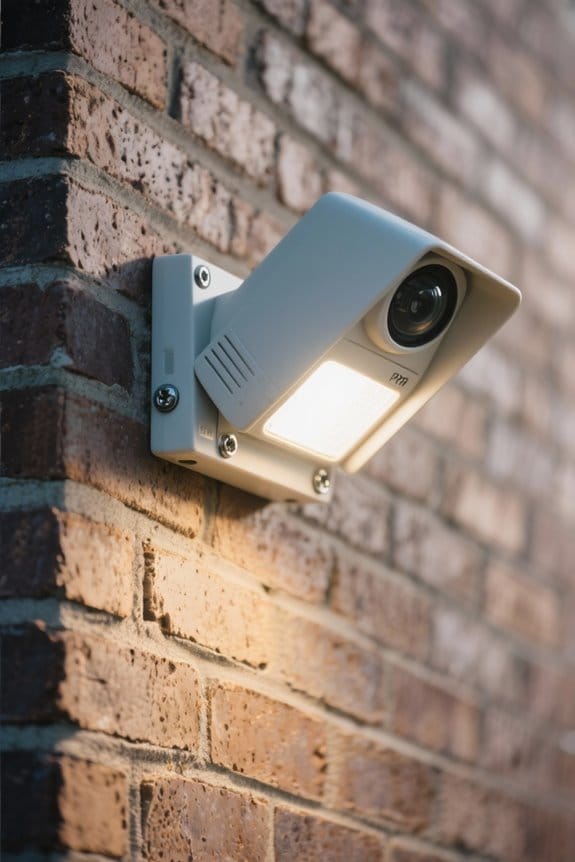
Although often overlooked, proper mounting height and sensor angle determine detection geometry, reducing blind zones and false triggers when configured between 1.8–3.0 m above grade. 1. Mounting recommendations: Install motion lights at 1.8–3.0 m (6–10 ft), this mounting height balances ideal detection, broader coverage and tamper resistance, while minimizing small animal activations. 2. Sensor orientation: Aim sensors downward and across expected travel paths, avoid head-on aiming, this orientation maximizes detection capabilities and reduces shadows and blind spots. 3. Adjustment and testing: Perform iterative angle adjustments during nighttime testing, document angles in degrees, verify coverage maps, and note areas requiring overlap from additional outdoor lighting. 4. Security outcome: Properly positioned fixtures improve detection, lower false triggers, and reinforce overall perimeter security. Follow maintenance schedules regularly. For optimal performance, ensure solar panels are oriented south at a 20-35° tilt to maximize sun exposure and charging efficiency.
Relying on a Single Light Without Overlap

Relying on a single motion-activated light often creates dark spots around outdoor areas, which provide concealment for potential intruders and undermine safety objectives. Assessment: measure coverage radius of each fixture, typically 10–15 meters for flood-style lights, map overlapping coverage to minimize blind zones and guarantee detection capabilities from multiple angles. Implementation: place multiple lights so beams overlap by at least 20–30 percent, stagger heights between 2.5–4 metres, orient sensors orthogonally to reduce false negatives, and integrate different light types for redundancy. Outcome: overlapping coverage deters crime more effectively, improves motion detection capabilities, and provides consistent illumination for routine use. Recommendation: conduct annual system tests, verify sensor overlap, use zone labelling for maintenance, and document installation parameters for future audits. Consider using plug-in PIR motion sensor lights with dusk-to-dawn sensors and adjustable brightness to enhance security and save energy.
Mounting Lights Where Vegetation Obstructs Coverage
A common mistake is mounting motion-activated fixtures too close to shrubs or tree canopies, which can block infrared and microwave motion sensors, absorb lumen output, cast shadows, and produce blind spots and frequent false triggers, thereby degrading detection reliability and perimeter illumination effectiveness. 1. Site assessment: position outdoor lighting at least 3–6 feet above shrub height and 6–10 feet clear of dense vegetation to guarantee sensor coverage and reduce obstructed zones, use 90° to 120° sensor arcs, and verify with walk tests. 2. Maintenance and layout: implement regular maintenance trimming schedules every 3–6 months, document landscape layout changes annually, and relocate fixtures when growth exceeds clearance. 3. Performance metrics: record false alarms and lux levels, adjust sensitivity and mounting angle to restore security benefits. For optimal outdoor lighting, consider using 2700K warm white LEDs which provide comfort and accurate color at night.
Using Incorrect Sensor Types for the Area
Section 1: Sensor selection overview, describing appropriate sensor technologies, their operational ranges, and situational trade-offs for reliable outdoor lighting detection. 1. Assessment: Avoid incorrect sensor types, select motion sensors based on area size, for porches and driveways choose PIR sensors with 6–12 meter range, for larger open areas use Microwave sensors that cover 15–30 meters and penetrate obstructions. 2. Trade-offs: PIR sensors respond to infrared, they can miss approach vectors and struggle in high wind or temperature change; Microwave sensors detect through fences, risking false alarms and privacy issues. 3. Solution: Consider dual-technology sensors in high-traffic zones to reduce inefficiencies and false alarms, adjust mounting height to 2–3 meters, evaluate environmental conditions during commissioning. Document detection zones, test at night and during adverse weather. Additionally, selecting bulbs with an IP65 outdoor rating ensures the sensors function effectively in various weather conditions, minimizing maintenance and enhancing longevity.
Skipping Manufacturer’s Installation Guidelines
Because manufacturers provide specific electrical, mechanical, and configuration parameters for each motion-light model, installers who bypass those instructions risk compromised performance, safety hazards, and code noncompliance. 1. Installation overview: Skipping manufacturer’s installation guidelines often results in improper wiring, incorrect mounting heights, and reduced detection capabilities, creating security vulnerabilities that permit evasion. 2. Mounting and aiming: Follow recommended mounting heights, typically 6 to 10 feet, and specified aiming angles to preserve motion sensors field patterns and range. 3. Configuration: Use prescribed sensitivity settings and timing settings, set per environment, to avoid nuisance activations or continuous operation, and to maximize bulb life. 4. Compliance and verification: Adhere to model-specific requirements to prevent non-compliance with codes, ease inspections, and support warranty and insurance claims. Ensure lights have adjustable heads and allow for separate solar panel placement to optimize charging. Consult manuals and document settings for records.
Improper Wiring and Overloading Circuits
Improper wiring creates electrical hazards when outdoor lighting circuits are installed without following installation practices such as weather-resistant cable, correct grounding, or secure connections, and motion lights wired in parallel can draw cumulative current exceeding design limits. Technicians should verify conductor gauge, for example use 12 AWG for runs up to 20 A, and maintain IP65-rated cable entries. Circuit overload occurs when installers exceed maximum wattage by daisy-chaining fixtures, causing breakers to trip or wiring insulation to overheat; a simple load calculation prevents this. Consult manufacturer’s specifications for fixture wattage and limit total connected load to 80% of circuit rating. Regular inspection, repair of damaged connectors, hiring a certified electrician guarantee safety and reliable operation. Label outdoor lighting circuits clearly, permanently today. Hardwired installations enhance security but may be technically complex, requiring adherence to proper installation guidelines to ensure optimal performance and longevity.
Failing to Adjust Sensitivity and Timing Settings
1. Adjust sensitivity settings on a lighting system of motion lights to reduce false triggers from animals, wind, or foliage, set PIR sensors to detect 3–6 meters for walkways and 10–12 meters for driveways, use customizable detection ranges to limit zones. 2. Configure timing settings so light activation remains for 15–60 seconds in low-traffic areas, and 60–180 seconds in high-traffic zones, preventing security risks from premature shutoff. 3. Regularly reviewing and recalibrating these parameters after landscaping changes or new pets guarantees consistent detection, preserves the bulb’s lifespan by minimizing unnecessary cycles, and improves energy efficiency through fewer activations. 4. Test adjustments at dusk and dawn, document settings, follow manufacturer guidance. Record sensor angles, note environmental variables, schedule quarterly reassessments. 5. IP65 waterproof rating is crucial for ensuring that outdoor lights can withstand various weather conditions, offering durability and consistent operational performance.
Neglecting Regular Maintenance and Testing
Section 1. 1) Regular maintenance and testing preserve outdoor lighting reliability, schedule inspections every 90 days and after major storms to verify function. 2) Inspect motion sensors for obstructions, clear debris within 5 cm of sensor lenses and remove vegetation encroaching within a 1.5 m radius. 3) Monitor bulb lifespan, replace bulbs at 50–70% of rated hours, to prevent reduced security and inconsistent energy consumption. 4) Calibrate sensitivity and timing during testing, adjust detection cones to 90–120 degrees and range to 6–12 m to reduce false triggers from environmental factors. 5) Document results and log corrective actions, update positioning after landscaping changes, and retain records for system performance verification. Perform functional tests at dusk and dawn, using a meter to record lux and current draw.
Frequently Asked Questions
Where Should You Not Place a Motion Sensor?
Like a moth, one should not place motion sensors in indoor placement facing direction at windows or vents; avoid installation height, shadow zones, proximity issues, lighting intensity and environmental interference; consider sensor sensitivity, activation range.
Where Should Outdoor Security Lights Be Placed?
Lights are placed six to ten feet high for motion sensor height, ensuring driveway illumination and garage security lights; porch light placement, patio lighting tips to expand backyard coverage, landscape lighting ideas, sensor angle adjustment.
Do Motion Lights Deter Burglars?
Yes, they reduce intrusions; motion light effectiveness complements burglary prevention measures, outdoor lighting benefits. Security technology advancements, neighborhood watch impact, landscaping and security, light color influence, motion sensor sensitivity and smart home integration strengthen deterrence.
What Are Common Problems With Security Lights?
Common problems include installation errors, incorrect sensitivity, improper aiming, obstructed views, insufficient coverage, wrong wattage, poor lighting, weather exposure, and lack of maintenance causing failures, false triggers, glare, reduced deterrent effectiveness, slower response times.


