As an Amazon Associate, we earn from qualifying purchases. Some links on this site are affiliate links at no extra cost to you. Our recommendations are based on thorough research and editorial judgment.

How to Avoid Glare and Light Spill on Neighboring Properties

1. Select full-cutoff, downward directional fixtures (0% uplight), 2700–3000K LEDs, 50–300 lm for paths, and narrow beam optics (10°–30°) to limit lateral spill; use shrouds, baffles, and shielded housings. 2. Aim fixtures 30°–45° down, mount low for pathways (≤18 in), calibrate with a lux meter to <1 lx at property line. 3. Use timers, motion sensors, dimmers, and document settings. 4. Verify compliance with local codes, perform photometric calculations, adjust settings. Technical guidance available below.
Key Takeaways
- Use fully shielded, directional fixtures (full-cutoff) to prevent upward and lateral light spill onto neighboring properties.
- Aim lights downward and limit tilt to 30°–45° to avoid shining into windows and adjacent yards.
- Choose low-lumen, warm-white (2700K–3000K) LEDs with appropriate beam angles for task-specific illumination.
- Implement timers, motion sensors, and dimmers to reduce operating hours and unnecessary brightness.
- Communicate with neighbors, measure illuminance at property lines (<1 lux ideally), and adjust fixtures accordingly.
Start With the Right Fixture Design
When selecting exterior luminaires, prioritize shielded, directional fixtures that limit upward and lateral light distribution, thereby reducing glare and trespass into adjacent properties, neighborhoods, or windows; specify full cutoff or downlight-rated housings with beam angles between 15° and 60°, depending on task requirements, to concentrate illumination. 1. Fixture selection: Choose the Right Fixture type for residential contexts, including path lights, low-voltage spotlights, and wall-mounted downlights, which provide targeted illumination with minimal Light Spillover. 2. Glare control: Use shielded or shrouded designs and frosted or diffused glass to soften intensity and reduce direct glare for neighboring residents. 3. Exclusions: Avoid open-bulb fixtures and high-mounted floodlights, as they produce uncontrolled distribution and increased trespass. Select adjustable fixtures for flexibility, while limiting lumen outputs to task-appropriate levels. Additionally, consider outdoor lighting options with shatterproof materials to ensure durability and reduce maintenance due to breakage.
Aim Lights Carefully

Several exterior luminaires require precise aiming, with uplights set between 30° and 45° vertical tilt to minimize window intrusion and neighbor glare. 1. Uplights: Angle fixtures 30°–45°, mount below canopy or grade, verify beam intercepts intended facade, this reduces direct glare and light trespass into adjacent dwellings. 2. Path and low fixtures: Keep mounting height 18 inches or less, orient lenses downward, use shields or visors to confine light to walkways, perform on-site checks from property line. 3. Flood and security lights: aim lights carefully, aim beams at ground plane or main structure, avoid upward tilt, adjust to eliminate skyward spill. 4. Verification and maintenance: Make small incremental adjustments, assess from neighbors’ vantage points regularly, document settings and retain consistency. Consider using energy-efficient bulbs to reduce electricity consumption and enhance cost-effectiveness over time.
Control Brightness and Beam Spread

1. Select appropriate lumen levels and beam angles to control brightness and minimize light trespass on neighboring properties; use low‑lumen LEDs of 50–300 lumens for pathways and accents, choose narrow 10–30° beams for focused features, and wider 40–60° beams for broader zones. 2. Maintain warm white color temperatures between 2700K and 3000K to reduce glare and improve visual comfort, aim fixtures downward and shield optics to prevent skyward emission, and prioritize subtle illumination over intense brightness to preserve nighttime character. 3. Implement precise aiming and mounting heights, document beam spread on a site plan, and verify results at night, adjusting angles and shielding until spill is eliminated. Reassuringly, these measures yield compliant, neighbor‑friendly lighting without sacrificing site safety or aesthetic objectives and reduce complaints. Modern solar lights, such as those with IP65 or IP68 waterproof ratings, can withstand various weather conditions and contribute to effective outdoor lighting solutions.
Recommended Products

UL/cUL LISTED - VOLT products are UL Listed for safety; most competitors' landscape lighting products on Amazon are not.

【Powerful Design】: 300 Watt 27000 Lumen Flood Light, 180° Beam Angle, Adjustable Metal Bracket, 2800-3200K Warm White, 369 LEDs, 2835 LED Chips Energy Saving, IP65 Waterproof, No flickering, Long Lifespan.

VERSATILE OUTDOOR LIGHTS: Lithonia Lighting ESXF LED Floodlight delivers a wide 7x7 beam spread of bright outdoor light for commercial and residential applications; It offers 36 configurations for signage, driveways, buildings, and security lighting
Use Timers, Dimmers, and Motion Sensors

Section 1 — Purpose and functions: Programmable control devices, including astronomical timers, smart dimmers, and passive infrared (PIR) or microwave motion sensors, provide predictable, configurable suppression of unnecessary outdoor lighting, reduce glare and spill, and allow precise alignment of illumination with site activity patterns. 1. Scheduling and energy: Timers enable automatic shutoff at defined times, for example between 23:00–05:00, reducing light trespass after midnight, conserving energy, and supporting neighbor privacy. 2. Adaptive activation: Motion sensors should be applied to low‑traffic areas such as driveways and service yards, calibrated for 5–10 m detection ranges, with adjustable hold times to limit duration. 3. Dimming and control: Smart dimmers permit stepwise or continuous reductions to 10–50% lumen output, allowing task‑specific illumination while minimizing over‑illumination. Installation should follow manufacturer specifications. Wide-angle PIR sensors enhance coverage area and ensure reliable activation, which is crucial for effective lighting management and security.
Embrace Dark Sky Principles

All exterior lighting should adhere to Dark Sky principles to eliminate upward light, minimize glare, and limit spill, ensuring fixtures are fully shielded so no light is emitted above the horizontal plane, mounted and aimed to illuminate target surfaces, and specified with lumen output and color temperature; 1. Specification: Select Dark sky friendly lighting, choose fully shielded fixtures, limit point-source output to 300–800 lumens for walkways, 1,000–2,000 lumens for drive areas, and use 2700K–3000K to reduce blue wavelength emission and light pollution. 2. Aiming and placement: Mount fixtures at calculated heights, typically 0.6–1.2 m for path lights, 2–3 m for task lighting, tilt and aim precisely to confine distribution. 3. Compliance: Verify fixtures meet IDA Dark Sky standards, document lumen budgets, adjust as needed. When selecting waterproof patio lights, consider the weatherproof rating to ensure the fixtures can withstand harsh conditions while maintaining efficient operation.
Create Natural Light Boundaries With Landscaping
- Section 1: Plant Barriers. Strategically place tall trees or shrubs along property edges, spacing 3–6 meters apart, heights 3–6 meters, to absorb or deflect stray light from landscape lighting and reduce glare onto adjacent homes.
- Section 2: Layering and Berms. Use layered vegetation with low-growing plants (0.2–0.5 m) at walkways, medium shrubs (0.8–1.5 m), and taller trees behind, incorporate 0.3–0.9 m berms to block line-of-sight from light fixtures, thereby containing illumination.
- Section 3: Fixture Coordination. Specify downward-directed, shielded light fixtures, aim at targets, limit lumen output to 200–800 lm per fixture, and maintain vertical planting distance of at least 1 m from fixtures for effective diffusion. Adding IP65 waterproof rating ensures that the fixtures can withstand various weather conditions. This strategy preserves privacy, improves neighbor comfort, and meets practical site-specific photometric objectives, and safety.
Recommended Products

Constructed with a solid die cast aluminum and powder coated finish. Features an up and down light.

Weather-resistant and rust-resistant, this porch lighting fixture sturdy aluminum construction with water ripple glass, suitable for wet locations. The black finish suits any house decoration.
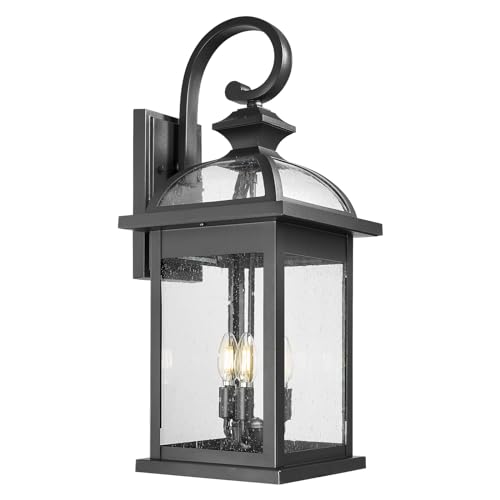
26inch LARGE WALL LIGHT - 12"(L)*12"(W)*26"(H) ; Darkaway 3-light large outdoor lights fixtures are built to last with reliable quality aluminum and weather-resistant design, rust-proof, waterproof, which is suitable for any weather conditions like, heavy rain, snowy, icing, hot weather, etc.
Test and Adjust Lighting After Dark
A systematic nighttime test establishes a baseline for photometric performance, identifies primary glare sources, and quantifies light spill relative to property lines and adjacent window apertures. 1. Inspection protocol: After installation, perform observations from multiple vantage points at least 30 minutes after sunset, stepping back 10–30 m to evaluate brightness gradients, then record fixtures exceeding target luminance. 2. Angle and aim: Adjust uplights to sit between 30° and 45° off window centers, tilt down to reduce angular spill, and verify beams do not cross neighbor windows. 3. Controls: Employ dimmers and timers to lower lumen output during late hours, schedule reductions to comply with ordinances. 4. Reassessment: Periodically test and adjust lighting, document results, and Prevent Light Trespass through corrective calibration, and maintain compliance. Additionally, consider utilizing energy-efficient lights which can save up to 80% to 88% on energy costs, thus reducing environmental impact while enhancing security.
Use Shrouds, Shields, and Accessory Baffles
When installing outdoor fixtures, use shrouds, shields, and accessory baffles to control beam spread, reduce glare, and limit light trespass onto adjacent properties. 1. Selection: choose full-cutoff fixtures with integrated shrouds, shields, or add-on baffles, specify beam angles of 10°–40° for accent lighting, 60° for area lighting, and select 3000K or lower correlated color temperature. 2. Placement: mount fixtures at calculated heights, typically 0.5–1.5 times object height for wall washing, position shields to block line-of-sight from neighboring windows. 3. Installation: attach accessory baffles to trim beam, set tilt to avoid direct neighbor exposure, verify with lux meter aiming for <1 lx at property line. 4. Maintenance: inspect quarterly, tighten fasteners, realign as needed. Document adjustments, retain records, and communicate changes to affected neighbors promptly, regularly. Consider using IP65-rated ABS materials for outdoor fixtures to ensure they withstand various weather conditions and maintain their effectiveness over time.
Check Local Light Trespass Ordinances and Codes
How should a designer verify compliance with local light trespass ordinances and codes, ensuring fixture selection, aiming parameters, and installation meet municipal limits and covenants? 1. Review applicable local lighting codes and HOA covenants, identify lumen caps, vertical illuminance (lux) at property lines, correlated color temperature limits, and requirements. 2. Specify fixtures and aiming, choose fully shielded cutoff fixtures, select beam angles, mounting heights, and tilt limits to maintain lux limits at adjacent parcels. 3. Perform calculations and mockups, use photometric files (IES/IESNA), model illuminance contours, and measure lux at setbacks. 4. Document compliance, retain manufacturer data, permit approvals, and final test reports, reducing risk of fines and neighbor disputes. Provide on-site verification with calibrated meters, record results for municipal inspection and maintenance. Ensure the chosen fixtures have IP65 or IP66 ratings for durability against weather, which is crucial for outdoor use.
Communicate With Neighbors and Offer Practical Solutions
- Initiate contact: Begin with calm, documented communication, present measured lux values (≤0.3 lux at the property line), and describe beam angles in degrees and lighting distribution.
- Recommend technical solutions: Propose full cutoff fixtures, glare shields, and motion sensors, specify LED color temperature (≤3000K), lumen limits (≤800 lm per fixture), and shield tilt (downward 0–10°) to eliminate spill.
- Offer adjustments and resources: Suggest reducing brightness in steps of 25%, re-angling fixtures by 15–45°, or installing timers, provide examples of compliant products and installation diagrams, and offer to share manufacturer specifications and local dark-sky guidelines to facilitate cooperative implementation. Consider using solar-powered models for easy installation and sustainability in an outdoor lighting setup, as they can significantly reduce the need for complex wiring and contribute to energy-saving efforts.
Reassure parties that small adjustments typically reduce measured spill by 50% within one week, and document changes for code compliance and future reference promptly.
Frequently Asked Questions
How to Block Out Neighbours Security Light?
They can block a neighbor’s security light by installing tall privacy screens and outdoor curtains, adding dense hedges or trees, suggesting shielded fixtures or motion sensors to the neighbor, and using blackout blinds indoors also.
What Can I Do if My Neighbor’s Light Is Too Bright?
They can talk politely to the neighbor, suggest installing light dimmers or smart lighting, add shields or full-cutoff fixtures, use timers or motion sensors, consult local ordinances, and share resources reducing glare and light trespass.
How to Reduce Light Trespass?
Like a curtain, a homeowner reduces light trespass by installing full cut-off fixtures, applying light shielding techniques, adjusting beam angles and wattage, using timers or motion sensors, and reviewing outdoor lighting design, neighbor viewpoints regularly.
How Can We Reduce Light Spill?
They reduce light spill by using full cutoff outdoor lighting, narrow beam angles, shielded fixture design, aimed uplights (30–45°), low downward path lights, and timers/dimmers to limit intensity and hours, preventing trespass onto neighboring properties.


