As an Amazon Associate, we earn from qualifying purchases. Some links on this site are affiliate links at no extra cost to you. Our recommendations are based on thorough research and editorial judgment.


Motion Path Lighting Concepts for Modern Minimalist Landscapes

1. Definition: Motion path lights use PIR or microwave sensors and LED modules (100–200 lm, 25,000+ hr), typically low-voltage 12V or solar with IP65–IP68 enclosures, for unobtrusive activation along routes. 2. Placement: space path lights 0.6–1.2 m (6–8 ft) apart, bollards 3–6 m (10–20 ft) for driveways. 3. Controls: CCT 2700–4000K, adjustable beam optics, 0.5–3 s trigger, programmable timers. Further sections explain design, power sizing, and installation details. More technical specifications and placement diagrams follow.
Key Takeaways
- Use discreet motion-activated path lights to preserve minimalist aesthetics while providing safety and temporary illumination.
- Space low-profile fixtures 0.6–1.2 m apart (paths) or 3–6 m (bollards) for even, unobtrusive coverage.
- Specify 100–200 lumen LEDs with 2700–4000K CCT and Dark Sky optics to balance warmth and glare control.
- Choose corrosion-resistant housings, IP65+ ratings, and modular drivers for low-maintenance durability.
- Prefer solar or low-voltage systems with PIR sensors and waterproof connectors to maximize efficiency and simplify installation.
What Are Motion Path Lights?
1. Definition and Function: Motion path lights are outdoor fixtures equipped with passive infrared or microwave sensors, designed to detect movement along walkways and automatically provide illumination, enhancing visibility and deterring hazards. 2. Technical Specifications: Typical units use LED arrays producing 100–200 lumens, operate at low-voltage (12V) or solar power, and may incorporate Dark Sky Compliant shielding to minimize uplight. 3. Design and Materials: Available finishes include titanium or matte bronze, sized to mount at 12–24 inches above grade or embedded at stake heights of 8–16 inches, enabling integration with minimalist hardscapes. 4. Installation and Operation: Many models support DIY installation with simple wiring or solar placement, requiring minimal tools and basic site planning. They reliably activate within two to ten seconds of motion. Additionally, many motion path lights are rated for 25 ft effective range, offering optimal detection for residential pathways.
Why Motion-Activated Lighting Matters in Minimalist Landscapes
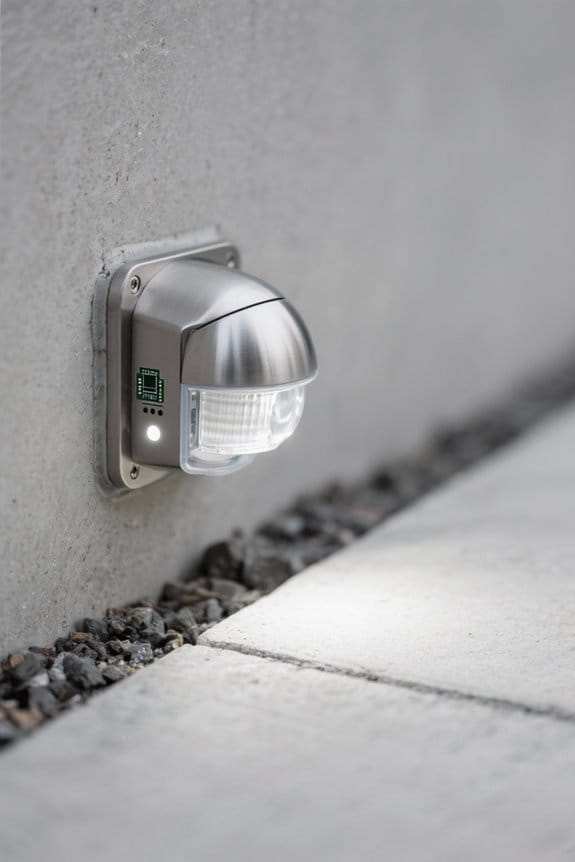
Building on the previous technical overview, motion-activated path lighting suits minimalist landscapes by addressing security, energy use, and aesthetic restraint. 1. Security: Motion-activated lighting illuminates paths and entries upon detection, typically activating within 0.5–3 seconds, producing 50–200 lumens to deter intruders and provide homeowner reassurance. 2. Energy efficiency: These fixtures operate only when triggered, cutting runtime by 70–90%, often using 0.5–2 W standby sensors and 1–10 W LEDs, compatible with solar or low-voltage systems. 3. Aesthetic integration: Sensors enable lights to remain off until needed, preserving negative space, with dimming to 10–30% initial output and warm color temperatures (2700–3000 K) to complement minimalist materials. 4. Placement guidance: Space fixtures 0.6–1.2 m apart along walkways to guide visitors without overlighting. Perform regular sensor calibration annually. Solar-powered motion sensor lights, such as those with IP68 weatherproof ratings, are ideal for ensuring durability and longevity in various environmental conditions.
Types of Motion Path and Driveway Fixtures
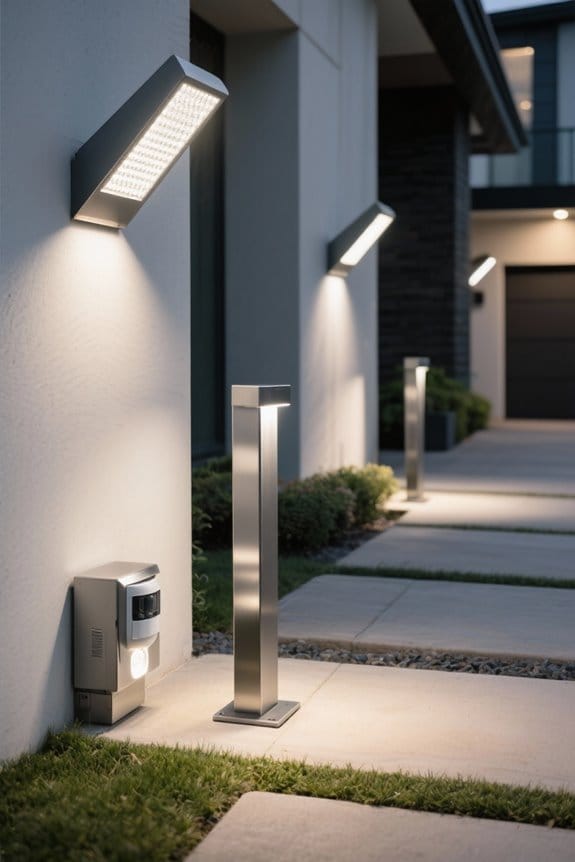
A concise taxonomy of motion path and driveway fixtures helps the specifier select appropriate hardware, balancing coverage, mounting, and control requirements across site conditions. 1. Bollards: typically 600–1200 mm tall, provide multi-directional light emission for broad coverage in open drives, recommend spacing 2–4 m for even illuminance, suitable for motion path lighting. 2. Smart path lights: integrate PIR sensors with 5–10 m detection, adjustable dimming profiles and 1–30 s-to-minutes timeout, require 12–24 VDC or low-voltage circuits. 3. Solar-powered lights: specify panels 1–5 W, battery capacity 2000–8000 mAh, expect 3–5 nights autonomy under partial sun. 4. Adjustable directional fixtures: offer 10°–60° beam angles and 0–360° aiming for targeted illumination. Specify LED sources at 2700–3000K for warm color rendering, ensuring visual comfort and material fidelity consistently. An important consideration for outdoor lighting is selecting energy-efficient options, such as LED bulbs, to reduce electricity costs while maintaining optimum brightness.
Design and Performance Features to Prioritize
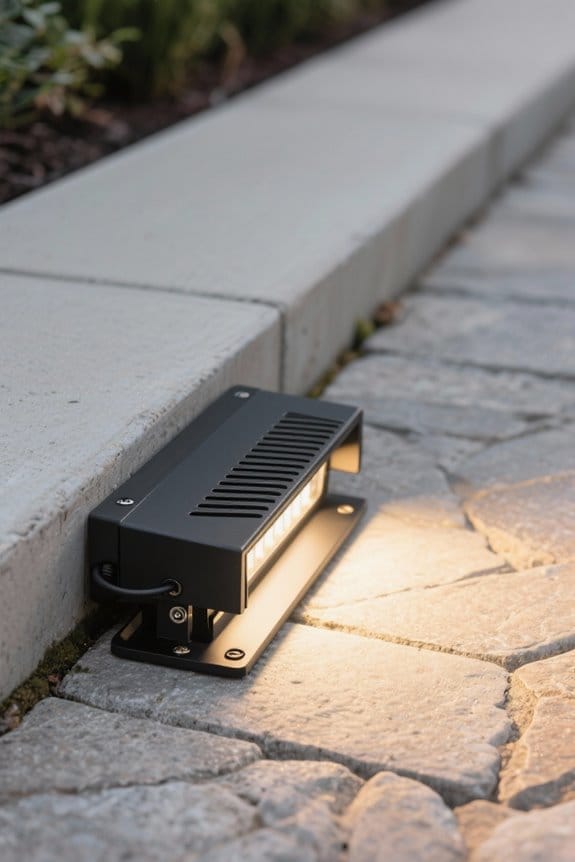
Several priority criteria govern selection and specification for motion path lighting, including source performance, optical control, mounting durability, and form factor, each requiring measurable thresholds and practical implementation methods. 1. Source specifications: prioritize LED modules rated 25,000 hours or more, specify 2700–3000K color temperature, 80+ CRI, and 5–15W power ranges to balance lumen output and energy consumption. 2. Optical control: require adjustable beam angles from 10° to 45°, incorporate shields and Dark Sky Compliant optics to limit upward light and reduce glare. 3. Materials and form: choose corrosion-resistant metals or polymer composites, IP65 or higher enclosures, low-profile fixtures under 150 mm height to preserve minimalist outdoor lighting aesthetics. 4. Mounting: use stainless anchors and vibration-rated brackets. Specify manufacturer warranties of five years minimum, documented. Modern outdoor lights can exceed 50,000 hours, providing long-lasting illumination and reducing the frequency of replacements.
Strategic Placement for Pathways, Driveways, and Garden Beds
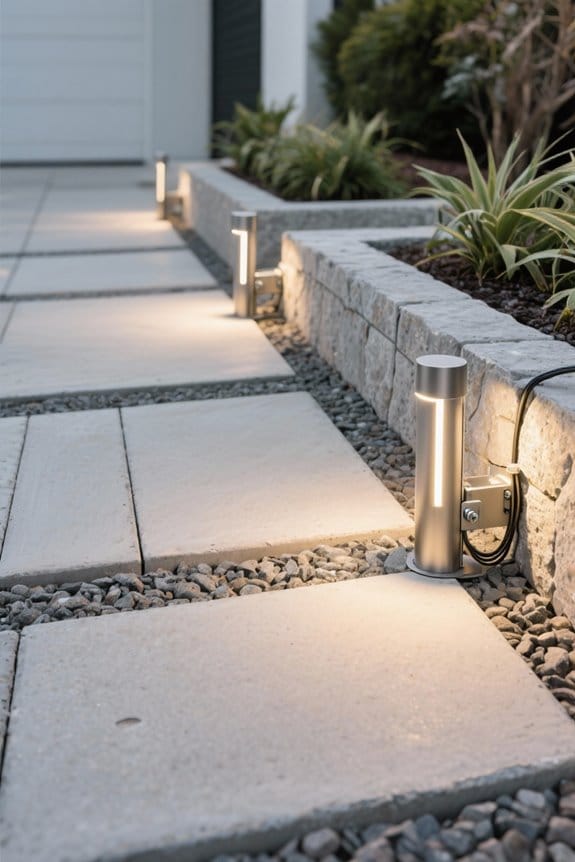
- Pathways: For front walkways, path lights should be spaced 6 to 8 feet apart, ensuring continuous illumination and clear edge definition. This spacing balances safety and visual rhythm, and reduces glare when fixtures are low-profile and aimed downward.
- Driveways: In larger or open drives, specify bollard lights set every 10 to 20 feet. These provide multi-directional emission for vehicle guidance and perimeter definition, while narrow drives retain path lights at 6 to 8 feet for pedestrian clarity.
- Garden beds and patios: Use low-profile path lights to outline beds and define outdoor living zones, place fixtures at berm or border elevations to accent textures and prevent dark spots.
- Sloped terrain: Install illuminated stair fixtures to mark risers, improving safety and visibility.
- Consider using IP65 waterproof rated outdoor lights to ensure durability and weather resistance, especially in areas exposed to varying climates.
Spacing, Lumens, and Beam Angle Guidelines
Guidance for motion path lighting establishes precise metrics for spacing, lumen output, and beam control, enabling safe circulation, cohesive sightlines, and adherence to minimalist design principles. 1. Spacing and layout: Fixtures are typically spaced six to eight feet apart to facilitate even illumination and safe passage; spacing may be adjusted for steps or curves, survey and mark positions before installation. 2. Lumen targets: Aim for 100–200 lumens per path light to produce a subtle glow without glare, lower values suit narrow corridors, higher values suit wider approaches. 3. Beam angle and control: Use narrower beams for focused accents, broader beams to cover larger areas, select adjustable, multi-directional fixtures to accommodate seasonal growth and changing site conditions. This balance supports minimalist aesthetics and functionality reliably. Low voltage systems are highly energy efficient and can reduce carbon footprints, making them an environmentally friendly choice for outdoor lighting.
Choosing the Right Color Temperature for Mood and Visibility
1. Section: Recommended ranges and application. The ideal color temperature for modern minimalist landscapes typically ranges from 2700K to 3000K, producing a warm, inviting glow that enhances surfaces and plant tones while maintaining visual comfort. Cooler options from 3500K to 4000K produce higher contrast and a more contemporary aesthetic, useful for pathways needing sharper visibility. Motion sensors with an effective range of 825 feet and coverage angles of 120-180 degrees effectively detect intruders, ensuring security in landscape settings. 2. Implementation: fixtures and zoning. Specify adjustable fixtures where possible, with CCT control between 2700K–4000K, allowing scene presets for evening and late-night tasks. Use mixed CCT strategically, for example 2700K for seating nodes and 4000K for critical ingress paths, maintaining 0.5–1.0 lux average on walking surfaces. 3. Visibility and mood: evaluation metrics. Measure contrast, color rendering, and glare, then adjust accordingly. Document settings and schedule changes seasonally for consistency.
Materials, Durability, and Weather Resistance
1. Modern installations require robust materials, specify aluminum or stainless steel housings of 1.5–3.0 mm thickness, powder-coated or anodized for additional corrosion resistance and consistent finish. 2. Sealing and ingress protection: use IP65 or higher enclosures with silicone gaskets, stainless fasteners, and sealed cable entries to prevent moisture, dust, and insect ingress, ensuring component longevity. 3. LED longevity and maintenance: select LEDs rated for 25,000 hours or more, plan for modular drivers and replaceable modules to reduce downtime and lifecycle cost. High waterproof ratings contribute to reliability, especially for installations exposed to extreme weather conditions, offering added durability and ensuring the fixtures remain functional in various environments. 4. Mounting and environmental considerations: specify stainless anchors, 25–50 mm burial depth for low posts, and Dark Sky compliant optics to reduce light scatter, reinforcing durability and regulatory compliance. Recommend routine inspections every 12 months, document findings, and replace seals as needed promptly.
Smart, Solar, and Low-Voltage Power Options
When integrating smart, solar, and low-voltage path lighting, designers should evaluate electrical loads, control interfaces, and site-specific solar insolation, specifying component ratings and installation practices accordingly. 1. Power selection: compare solar modules rated in watts and peak sun hours, low-voltage transformers sized for 12V systems with 20% headroom, and smart controllers with Z-Wave or Wi‑Fi integration. 2. Sizing: specify lumens per fixture, typically 100–200 lumens for low-voltage path lights, calculate run length and voltage drop. 3. Controls: implement motion sensors, scheduling, and remote override, guarantee compatibility with home automation protocols. 4. Installation: use waterproof IP65 fixtures, buried direct-burial cable for 12V, position solar panels at 30–45° for peak output. 5. Maintenance: monitor battery health and firmware updates. Replace worn batteries every three years routinely. Solar path lights reduce reliance on traditional power sources and require minimal maintenance, making them an eco-friendly choice for modern landscapes.
Styling Minimalist Outdoor Spaces With Motion Lighting
Although minimalist landscapes prioritize visual restraint, motion path lighting can be specified to preserve clean lines, enhance safety, and minimize energy use by using low-profile fixtures, narrow beam optics, and adjustable sensors to illuminate only occupied zones. 1. Placement: Specify fixtures at six to eight foot intervals, mounted low to the ground, aimed with narrow beams to limit spill light and preserve hard edges. 2. Specification: Select LED motion path lighting with titanium or hematite finishes, 2700–3000K color temperature, and adjustable time and sensitivity settings to reduce consumption. 3. Implementation: Use low lumens per fixture and site-specific zoning, calibrate sensors to occupied zones only, and test nocturnally to confirm uniformity and safety. Reassurance: Measures support minimalist aesthetics, enhance security and efficiency, reduce operational costs. Additionally, choosing solar-powered models with efficient energy conversion can further lower electricity costs while promoting sustainable practices.
Maintenance, Installation, and DIY Best Practices
Section 1—Installation and placement provides step-by-step guidance for locating low-voltage motion path lights at six to eight foot intervals, ensuring even coverage and clear sightlines. 1. Site assessment: Determine edge distances, calculate spacing, note sightline obstructions, plan wiring routes for outdoor runs, and select fixtures rated for wet locations. 2. Installation procedure: Use low-voltage transformer sizing, run buried cable 6 to 12 inches deep, secure connections with waterproof connectors, and mount fixtures at 12 to 18 inches height for ideal detection. 3. Maintenance and testing: Clean lenses and sensors monthly, clear debris within one foot, test motion sensors seasonally and after vegetation changes, and choose corrosion-resistant materials to minimize long-term upkeep. Components are easy to install. Record installation details for warranty and future reference.
Frequently Asked Questions
Do Motion Path Lights Affect Local Wildlife or Nocturnal Insects?
About 60% of nocturnal insects are affected by artificial light. They can disrupt insects and alter Wildlife Habitats through attraction, disorientation, and predator–prey shifts; careful fixture selection, amber LEDs, shielding, and reduced duration mitigate impacts.
Can Motion-Activated Outdoor Lights Violate Local Light Pollution Ordinances?
Yes, motion-activated outdoor lights can violate local light pollution ordinances. Municipal Local Regulations may restrict glare, duration, and lumen output; compliance requires fixture shielding, proper aiming, timers, and documenting permits to avoid citations and fines.
Will Installing Motion Path Lighting Impact Homeowner Insurance Premiums?
Quietly, carefully, consistently, a homeowner can see Insurance Impact: insurers may offer reduced premiums for improved security, but changes are insurer-specific and conditional on installation quality, permits, and claims history, so savings are not guaranteed.
How Do Motion Sensors Handle Power Outages and Backup Operation?
Motion sensors often lose mains power during outages but can continue via internal batteries, external battery packs, or UPS/solar hybrids. Power Resilience hinges on battery capacity, smart switchover, and system design to preserve core operation
Are There Privacy or Data Concerns With Smart Motion-Activated Lighting?
61% of consumers express privacy concerns about smart home devices. Yes, smart motion-activated lighting can raise privacy and Data Security issues—data collection, cloud transmission, and vendor practices create risks unless encrypted, minimal, and locally stored.


