As an Amazon Associate, we earn from qualifying purchases. Some links on this site are affiliate links at no extra cost to you. Our recommendations are based on thorough research and editorial judgment.


Common Failure Points in Outdoor Motion Fixtures and How to Avoid Them

1) Sensor and power: motion sensors (PIR 30–60 ft, 180°; microwave) fail from dirt, moisture, incorrect photocell wiring, voltage drop over runs >50 ft, and loose connections; clean lenses, use IP65 fixtures, and tighten terminals. 2) Wiring and corrosion: inspect 18–16 AWG outdoor cable, seal with silicone and heat‑shrink, replace corroded 316 stainless or powder‑coated fittings. 3) Settings and placement: adjust sensitivity, mount 7–10 ft, avoid obstructions. More procedural checks and component selection guidance appear below.
Key Takeaways
- Faulty sensors: PIR or microwave sensors fail from dirt, temperature extremes, or age—clean lenses and replace outdated sensors regularly.
- Power and wiring: Loose connections, tripped breakers, or voltage drop cause outages—tighten terminals, test voltage, and use proper conductor gauge.
- Moisture and corrosion: Water intrusion and rust damage electronics—specify IP65+ enclosures, seal joints, and use stainless or powder-coated materials.
- Incorrect placement or alignment: Obstructions and wrong angles cause missed triggers or false activations—survey site, mount 7–10 feet high, and adjust detection zones.
- Incompatible bulbs or settings: Wrong lamp types, timer, or sensitivity settings cause flicker or constant illumination—use rated bulbs and calibrate timers/sensitivity.
How Motion Sensors Operate in Outdoor Fixtures
- Section 1: Sensor technologies and basic operation. Motion sensors in outdoor fixtures use passive infrared (PIR) to detect heat signatures at ranges typically between 30 and 60 feet, or microwave pulses that detect movement via Doppler frequency shifts. Photocell sensor integration prevents activation during daylight, improving energy efficiency and reducing wear. Wide-angle PIR sensors improve coverage area, and reliable activation enhances proactive security.
- Section 2: Configuration and timing. Sensitivity settings are adjusted to avoid false positives from small animals, with timing controls commonly set from 10 seconds to several minutes to conserve power.
- Section 3: Installation and environmental considerations. Environmental factors such as temperature, humidity, and obstructions affect detecting movement and require careful mounting and aiming for optimum functionality. Regular testing and periodic recalibration guarantee reliable performance across seasons and shifting conditions too.
Common Causes of Lights Not Turning On

Section 1: Power, sensor, and wiring faults account for the majority of outdoor motion fixture failures, including tripped 15–20 A circuit breakers, blown fuses, and voltage drops caused by undersized conductors over runs exceeding 50 feet. 1. Power supply: Verify breaker position, test for voltage at the fixture with a multimeter, inspect for voltage drop over long runs, and replace undersized conductors to prevent lights not turning under load. 2. Sensors and alignment: Adjust motion sensors, remove obstructions such as vegetation within 10–15 ft, and confirm sensor field covers intended detection zone. 3. Wiring: Inspect for loose connections, corrosion, and damaged insulation, reterminate with proper connectors. 4. Lamps: Replace burnt-out bulbs and use rated replacements to resolve common electrical issues. Perform scheduled preventive inspections. Additionally, ensure that the installation location is optimal for performance, especially in extreme weather conditions which can impact reliability.
Reasons Lights Stay On Constantly

Persistent illumination commonly results from sensor and timing faults, electrical wiring defects, or improper installation, each requiring distinct diagnostic steps and corrective actions. 1. Sensor sensitivity and placement: Overly sensitive motion sensor settings, set beyond recommended 10–30 foot detection zones, or mounting angles 45 degrees, produce constant triggers, adjust sensitivity or reposition, limit false detections. 2. Contamination and malfunction: Moisture, or dirt on lenses can lock sensors into active states, clean with wipes, replace seals, or install IP65-rated housings. 3. Timing and configuration: Timers set too long can cause lights fail to turn off, reset to 30–300 seconds as appropriate. 4. Electrical issues: Loose connections or faulty wiring cause feedback that prevents lights from cycling, inspect terminals, torque 12 in·lb, repair compromised wiring. To ensure durability, always select IP65+ rated products for weather resistance, as they provide better protection against environmental factors.
Flickering and Intermittent Lighting Issues
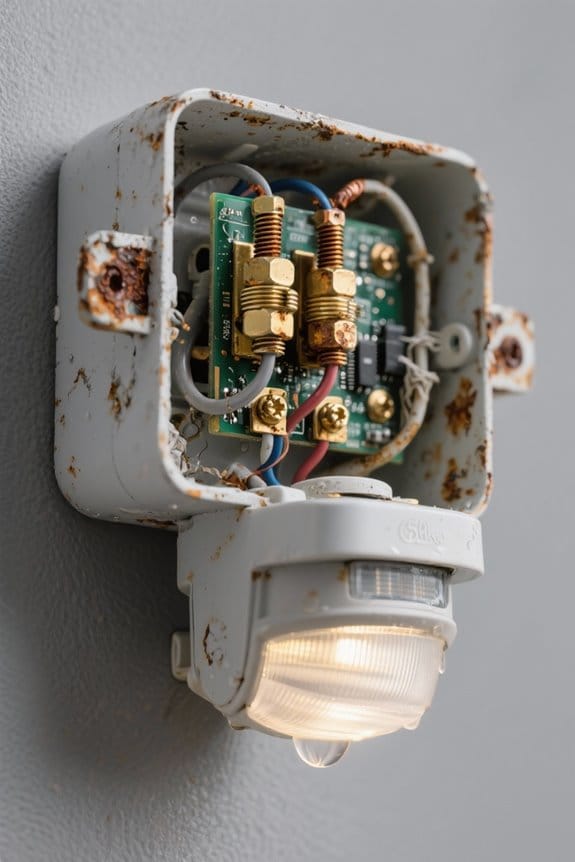
Frequently, flickering and intermittent operation in outdoor motion fixtures indicates loose connections, moisture intrusion, voltage drop, or circuit overload, necessitating targeted inspection and corrective action. 1. Diagnosis: Inspect junctions and tighten loose wiring connections to 25–30 in-lb torque on terminal screws, test continuity with a multimeter, and measure supply voltage within ±5% of nominal. 2. Moisture control: Use IP65 or higher rated outdoor fixtures, replace corroded fittings, apply silicone dielectric grease to protect contacts, and verify gaskets for compression. 3. Voltage management: For runs over 50 feet, increase conductor gauge to limit voltage drop below 3%, or add local drivers. 4. Load balancing: Redistribute loads to avoid overloaded circuits and schedule regular maintenance to prevent recurrence. Technicians should document findings and corrective steps taken. To ensure long-lasting durability, prioritize fixtures with a high waterproof rating, ideally IP65 or above, to protect against rain and snow.
Sensor False Triggers and Environmental Factors

- Causes and observation: Motion sensors often register false triggers from sunlight heating, nearby vegetation movement, and small animals, PIR elements respond to rapid infrared differentials across the detector field, causing unintended activations at ranges of 10 to 15 meters.
- Sensitivity and placement: Adjust sensitivity to match expected movement, set detection range to 3–10 meters for residential zones, mount sensors 2.5–3.5 meters high, angle them away from roads and reflective surfaces.
- Protective measures and maintenance: Install sensors under eaves or in sheltered niches, perform regular maintenance including cleaning every 3–6 months, inspect for obstructions, verify accuracy after adjustments.
- Calibration and testing: Use walk-tests across arc, and periodically adjust sensitivity until intended targets trigger reliably while environmental factors stop causing false activations.
- A vital factor in choosing lights for outdoor use is ensuring they are IP65-rated, which provides reliability against environmental challenges such as moisture and dust.
Wiring, Connections, and Power Supply Failures
- Inspect wiring connections and integrity, as loose or damaged conductors interrupt the power source and create common outdoor lighting problems that mimic sensor failures; check for corrosion, fraying, and proper insulation ratings.
- Address voltage drop by calculating conductor size using 120 V or 240 V system parameters, using AWG 12 for runs under 50 feet at 120 V, and larger gauges for longer runs, ascertain voltage at fixtures remains within manufacturer tolerances.
- Protect electrical systems with weather-rated junction boxes, IP67 fittings, and surge protectors rated for outdoor use to prevent spikes.
- Schedule preventive checks quarterly, because maintenance is key.
- Document repairs and component specifications for future troubleshooting. Replace degraded connectors with crimped, soldered, or gel-filled types, and verify grounding continuity with clamp-on testers regularly.
- Consider how environmental impacts affect sensor accuracy and choose models that are known for reliability in varied climates to enhance the lifespan and efficiency of your outdoor motion fixtures.
Bulb Selection, Compatibility, and Lifespan
When selecting replacement lamps for outdoor motion fixtures, technicians should prioritize bulb type, electrical ratings, and environmental certifications, because improper choices cause premature failure, sensor misreads, or safety hazards. 1. Bulb selection: Prefer LED sources rated 25,000–50,000 hours for reduced maintenance and energy consumption, verify base, wattage, and 120/240 V compatibility with fixture nameplate to avoid electrical failure, and choose products listed for outdoor use to tolerate temperature shifts. 2. Sensor compatibility: Confirm motion sensors accept low-wattage LEDs, test dusk-to-dawn circuits with the selected lamp, and replace outdated sensors when pulse-width modulation or inrush characteristics cause flicker or non-triggering. Regular scheduled replacement and documentation guarantee predictable lifespan and reliable operation. Technicians should log serial numbers, installation dates, and measured current draws after installation monthly. Plug-in PIR motion sensor lights, for example, offer a detection range of 316 ft and coverage up to 180°, which enhances their application in various outdoor scenarios.
Corrosion, Moisture, and Weather-Related Damage
Outdoor motion fixtures require deliberate design and maintenance strategies to prevent corrosion and moisture intrusion, since prolonged exposure to rain, snow, salt spray, and temperature cycling accelerates metal degradation, gasket failure, and electrical shorts. 1. Materials and coatings: Specify 316 stainless or powder-coated aluminum, apply 75 μm finish thickness, use silicone gaskets, these measures mitigate corrosion and weather-related damage in outdoor lighting systems. 2. Sealing and drainage: Guarantee IP65+ enclosures, bond and seal electrical connections with heat-shrink and silicone, provide 3–6 mm drain holes or channels to evacuate pooled water, avoid traps. 3. Inspection and maintenance: Inspect quarterly for rust, seal compression, and discoloration, clean debris, monitor fixture placement to prevent pooling, replace compromised seals promptly to preserve function. Most products feature robust materials and weather-resistant designs with an IP65 or higher rating, enhancing their durability and long-term performance. These steps extend service life.
Placement, Angle, and Mounting Best Practices
Proper placement and mounting follow from addressing corrosion and moisture risks, because sensor height, aim, and obstruction control directly affect detection reliability and equipment longevity. 1. Site survey and focal planning: Conduct a property survey to establish focal points for security, outdoor lighting, and visibility, determine ideal placement relative to walkways and entrances, and identify mounting locations at least 7 to 10 feet above to enhance motion sensors’ coverage and reduce small-animal triggers. 2. Angle and aim considerations: Set fixture angle to illuminate paths and thresholds without producing glare or shadowed zones, adjust tilt and rotation during commissioning for coverage. 3. Mounting and obstruction control: Clear line of sight, avoid situating adjacent to trees or hedges, and keep furniture or walls from blocking detection. Ensure that the weatherproof rating of your motion sensor bollard lights is at least IP65 to guarantee durability against rain and snow, as this will help maintain optimal performance in various weather conditions.
Routine Maintenance and Inspection Checklist
- Routine inspection schedule: A technician should perform routine maintenance of outdoor fixtures every season, approximately every 3 months, inspecting mounting bolts, checking waterproof seals, and confirming connections are secure, for example tightening to 5–7 Nm torque on common fixtures.
- Visual and functional checks: Inspect wiring for abrasion, UV damage, and proper strain relief, replace degraded cable with outdoor-rated 18–16 AWG as appropriate, and replace bulbs designed for outdoor use promptly when output drops.
- Sensor and lens care: Clean sensors and lenses with a soft cloth and non-abrasive cleaner to remove debris that impairs detection.
- Corrosion and moisture control: Look for signs of wear, corrosion, or water ingress at enclosures, reseal with silicone or replace gaskets when necessary.
- Ensure that the IP65 weatherproof rating is maintained by routinely inspecting the fixture for any cracks or damage that could compromise its resistance to rain and dust.
Document all findings.
Testing Sensors and Circuits With a Multimeter
1. Testing sensors with a multimeter begins with a visual inspection, then measuring sensor output voltage to confirm it falls within manufacturer range, typically 3–12V for low-voltage sensors or line voltage at 120V or 240V for integrated units. 2. Continuity checks require setting the multimeter to continuity, probing wiring and terminals to detect opens or shorts, a continuous beep indicates intact conductors. 3. Resistance measurement of the motion sensor should match specifications, record ohms readings and compare to datasheet limits, discrepancies suggest component failure. 4. Power supply voltage at the fixture must be measured under load; fluctuating readings imply deeper electrical problems and warrant professional evaluation. Document readings with date and location, track stability over time, establish thresholds for acceptable variance, and prioritize repairs
Upgrading to LED, Smart, and Energy-Efficient Options
Upgrading outdoor motion fixtures to LED and smart options delivers measurable reductions in energy use and maintenance, while requiring attention to electrical compatibility, photometric performance, and environmental ratings. 1. Energy-efficient and lifespan: LED bulbs reduce consumption up to 80%, provide 25,000–50,000 hours life, lower maintenance cycles, and cut replacement frequency by 25 times compared with incandescent. 2. Smart integration: smart lighting enables remote control, scheduling, and activity monitoring via smartphone apps, improving response and diagnostics, but requires compatible drivers, secure networks, and firmware updates. 3. Environmental and photometric considerations: choose IP65+ rated outdoor lights, verify lumen output and color temperature, and select sensors that dim based on ambient lux to avoid common issues. 4. Implementation: test drivers and seals, document settings, schedule firmware checks.
Recommended Products

12.0 Megapixel Full HD Realtime Recording 32 Channel 12MP Commercial-Grade NVR and (32) 8MP 4K Weatherproof Outdoor/Indoor Color Night Vision POE IP Dome Cameras (Built-in microphone and 2.8mm 135° wide angle lens)

Dusk to Dawn Technology – Keep your home as efficient as possible, with dusk to dawn technology the animated flame bulb will immediately ignite when the sun starts to set

[4K Ultra HD and Color Night Vision] This incredible 4K CMOS image sensor allows the camera to capture more light, resulting in improved color, contrast, and low-light performance. With 4K resolution, you can record everything in stunning detail with high pixel count and digitally zoom in on objects in the distance without losing any quality. Experience the ultimate clarity and enhanced visibility with our advanced technology.
Frequently Asked Questions
Why Do Motion Sensors Fail?
Every cloud has a silver lining, sensors fail because motion sensor sensitivity is misset, environmental effects degrade function, wiring issues and power supply faults interrupt operation, placement mistakes hinder detection, and outdated technology wears out.
How to Troubleshoot an Outdoor Light Fixture?
They troubleshoot an outdoor light fixture by performing circuit checks, inspecting for bad wiring, testing and performing bulb replacement, ensuring proper fixture placement, doing lens cleaning, and adding weather protection effectively to prevent future failures.
Why Is My Motion Sensor Going off for No Reason?
The sensor is likely triggering from false triggers caused by environmental factors, poor placement techniques, wiring issues, or excessive sensitivity; the owner should adjust sensitivity, inspect wiring, and follow maintenance tips to reduce unwanted activations.
What Is the Rule of Thumb for Outdoor Lighting?
About 20 lumens per square foot is the rule of thumb; a statistic visualizes brightness. It guides outdoor lighting basics, energy efficiency tips, fixture placement strategies, weather resistance features, bulb selection guide, and maintenance schedules.


